






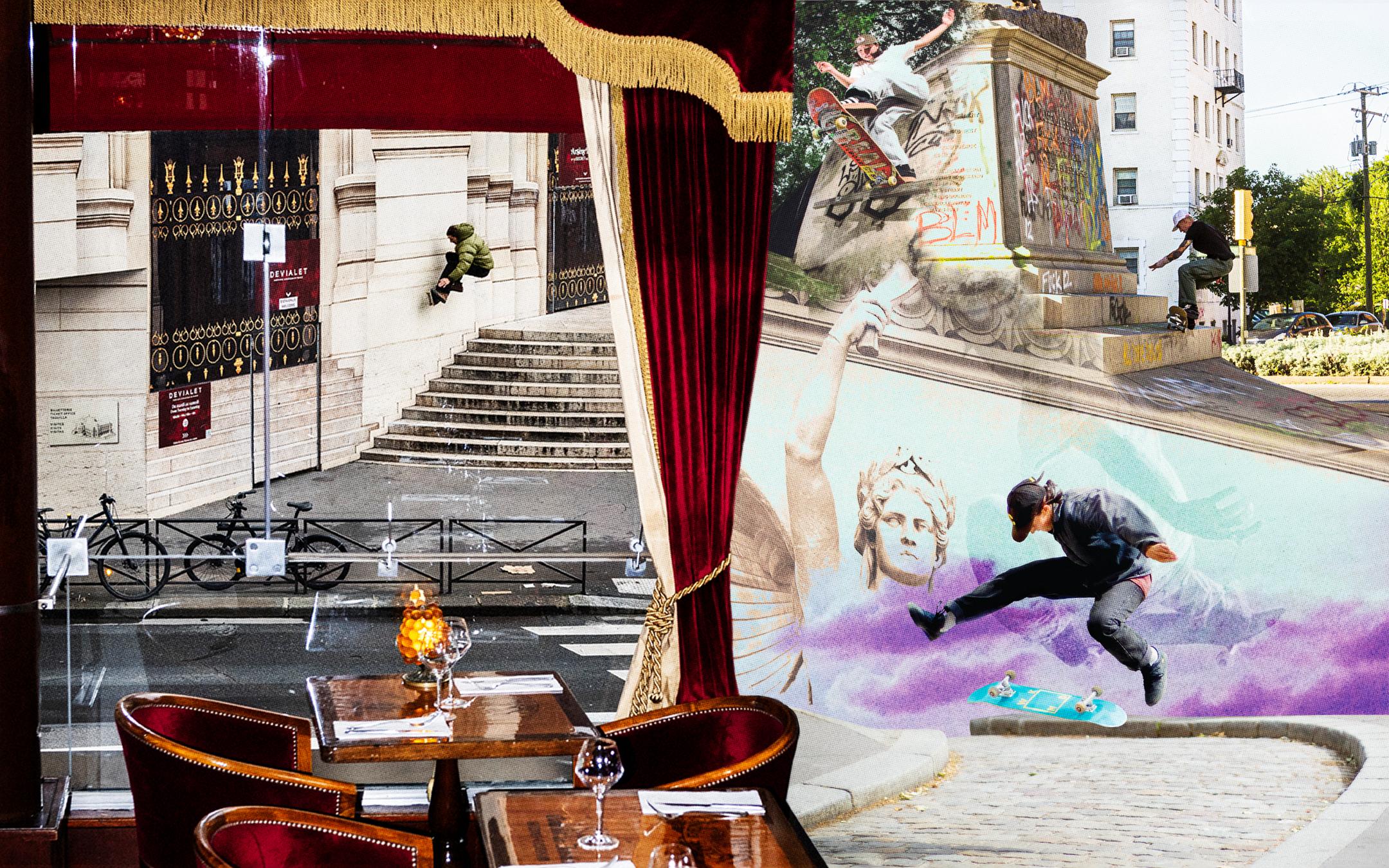
🔑 Introduction, Interviews & Collages by Farran Golding
📷 Headline Composition: Román González by Alex Pires for Free Skate Mag, Momiji Nishiya by Allan Carvalho for Mess Skate Mag, Corey Bittle by Tyler Storm Brady for Skate Jawn, Alexis Sablone for Golden Hour and Brad Cromer for PLANK by Matt Price
Walking around chairs wrapped in merlot fabric, the waiters of L’Entracte Brasserie in Paris went about their morning shift, placing silverware and wine glasses, unfazed by the camera flashes of photographer Alex Pires.
The restaurant faces the Palais Garnier Opera House, a building that is almost two centuries old, and as iconic as other Parisian landmarks such as Notre-Dame and Sacré-Coeur. Outside the opera house, an image of the Palais Garnier’s façade was depicted on a temporary wall, producing an illusion the French call “trompe-l’œil.” It directed visitors to entrances above and below a stairway. Two hours before the venue opened at around 7 A.M. on a damp, December 2024 day, Román González threw himself into the temporary façade of the Palais, clinging onto a frontside wallride down the stairs.
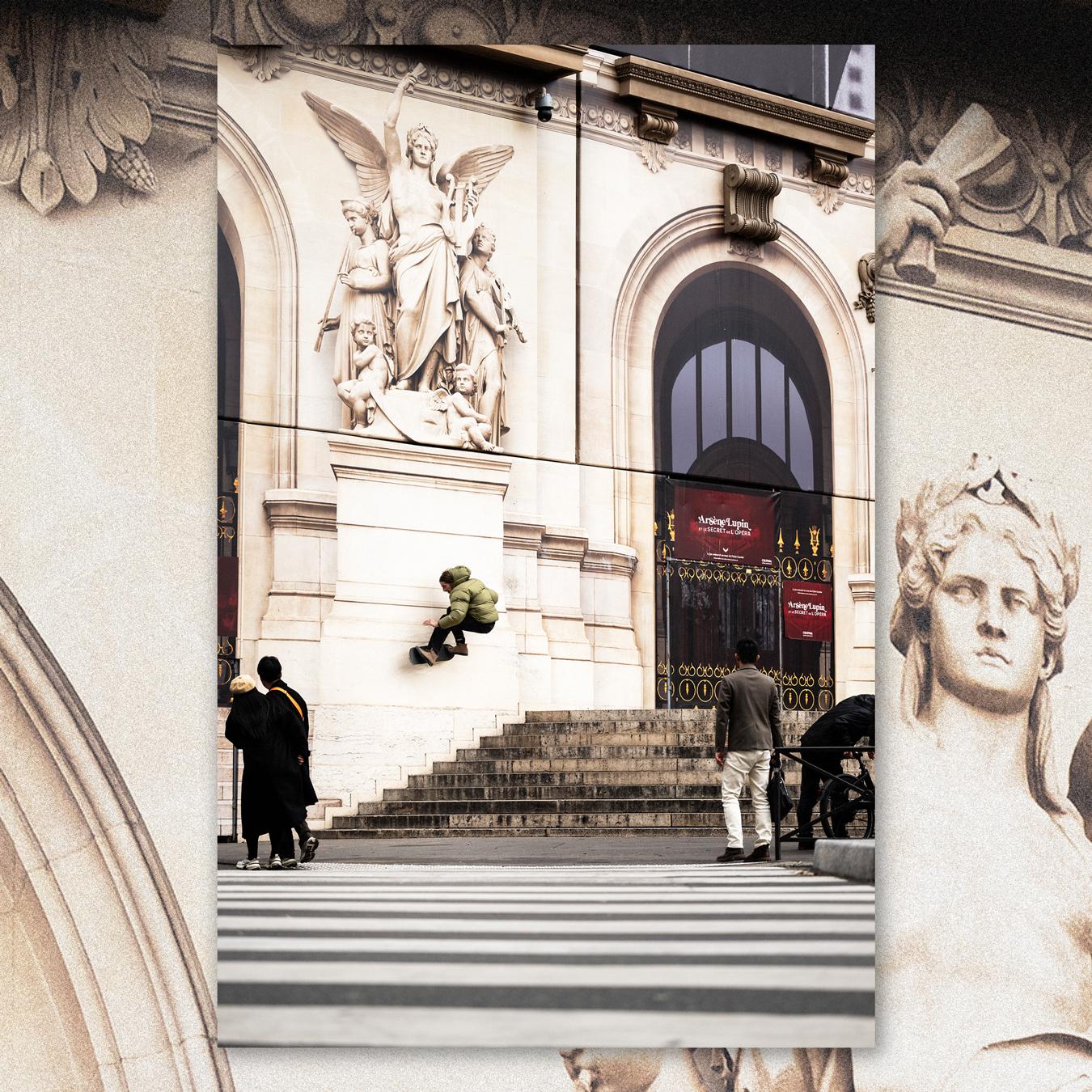
An earlier attempt at wallriding the Palais Garnier by Román González. Photo: Alex Pires.
Pires, González and friends had warmed up across the street in L’Entracte and borrowed materials to dry up the Palais Garnier stairs. From outside the restaurant, Pires shot a photo of González’s wallride that he was pleased with. However, González wasn’t able to ride away from the trick before security kicked them out. He tried the trick again later that night, albeit without Pires, but it rained. The crew took refuge at the restaurant again for a round of beers. As the evening went on, González headed upstairs to use the restroom and something caught his eye.
On L’Entracte’s upper floor, the brasserie’s curtains and mahogany interior surrounded a window that framed the wall and stairs outside the Palais Garnier. “It was too good to be true,” says Pires of a photo that González texted him. “Those angles are what you’re always after, but it almost never aligns.”
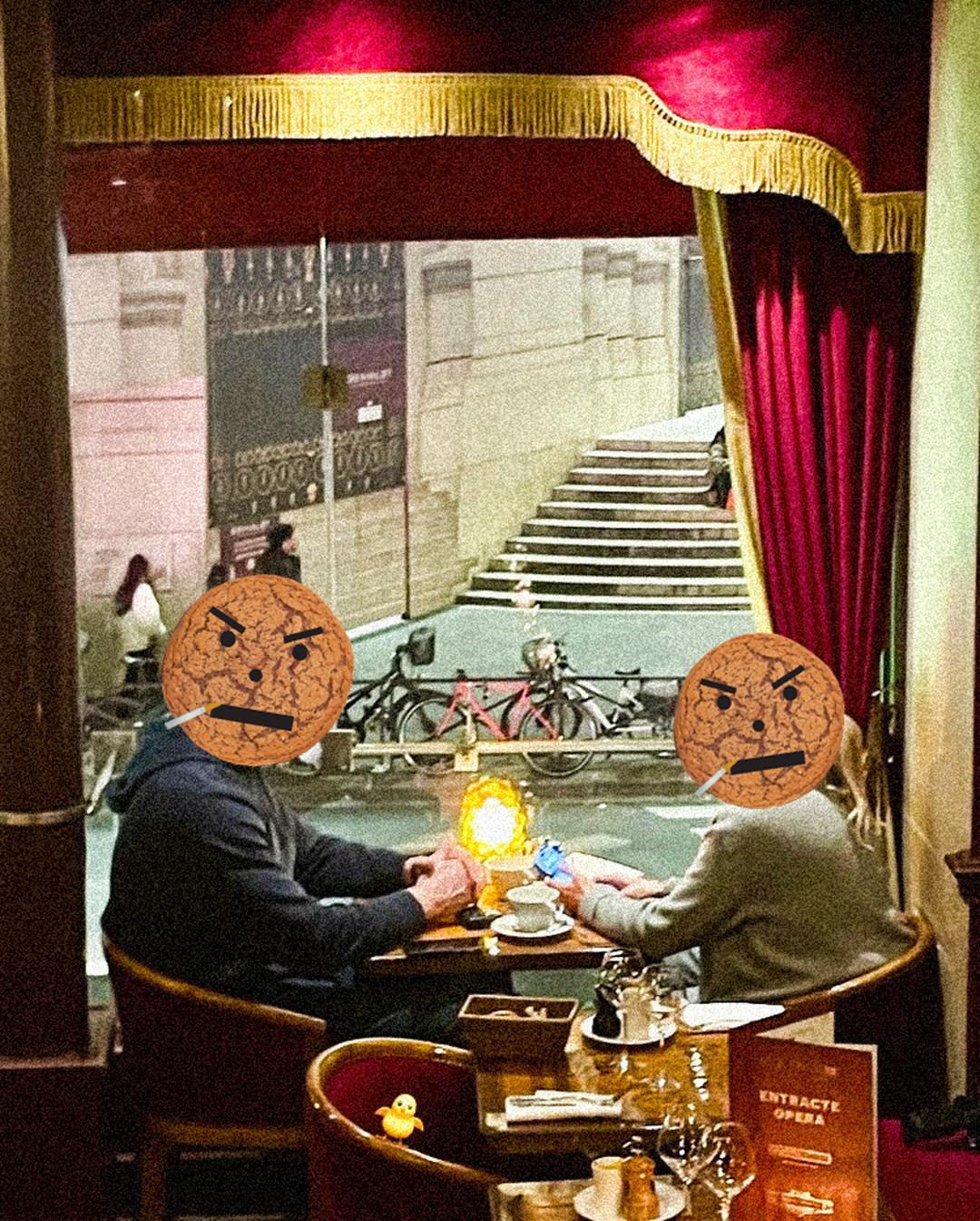
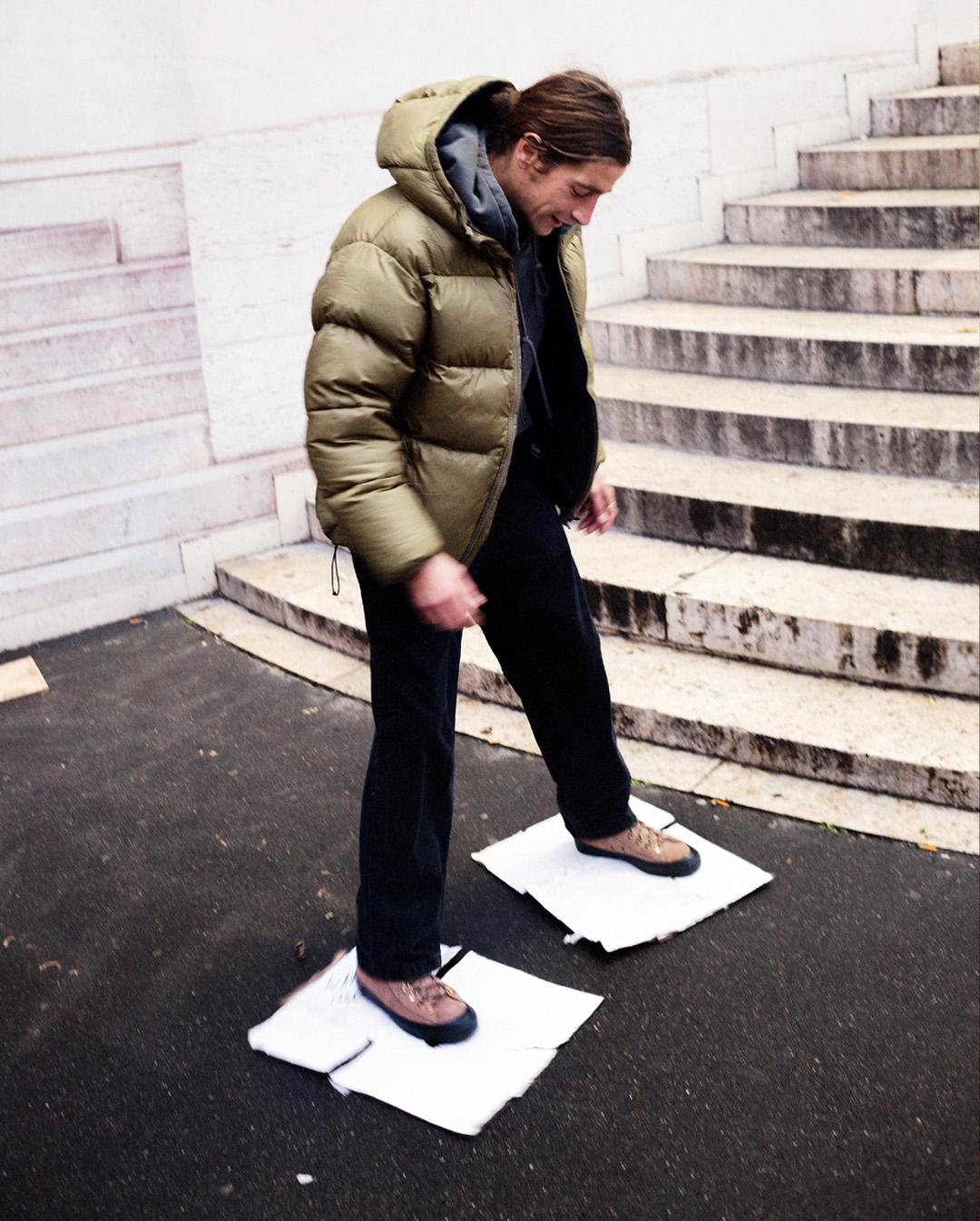
Reconnaissance and preparation for the cover. Photos: Román González and Alex Pires.
Not long after, they met up for their usual morning coffee at L’Entracte. Pires explained to the restaurant’s bartender their idea to shoot a photo from the upper level, while González dried the stairs of the opera house once again. “She wasn’t feeling it,” says Pires, who had even “dressed smarter” in an attempt to swing the restaurant’s staff. Instead, he ordered another coffee and pretended to use their restroom, finding an angle to shoot through the window as waiters set the place up for the day. “I was on my toes because I couldn’t see the run-up or hear Roman skate. It was hard to predict when he would appear in the frame. It was the most silent session ever,” says Pires of the 45 minutes he spent shooting the photo, which ran on the cover of Free Skate Mag #58 in January 2025.

Roman González, frontside wallride. Paris, France. Free Skate Mag #58 (January 2025).
Photo: Alex Pires.
To Sam Ashley, photo editor and co-founder of Free Skate Mag, Pires’ photo encapsulates the magazine’s vision for covers. Although captivating scenery and architecture are hallmarks of Free‘s front page, those elements don’t do the heavy lifting. They elevate skateboarding, which is impressive in itself. “It’s about skateboarding within that [architectural] context of the world. To me, that’s what’s interesting,” says Ashley. “Skate photography is pointless if it’s only giving you what the footage does.”
Fisheye renegade and Golden Hour visionary, Matt Price, was present for one of González’s attempts at wallriding the Palais Garnier. “I didn’t think there was anything to do with shooting it from where we were at on the street. I had a ‘standard’ long-lens shot from down low,” says Price. “It’s one thing for someone to out-do your photo. It’s another thing for someone to out-do it that hard. I was so hyped on Pires’ photo and at the same time, like, ‘Wow, I didn’t even consider that,'”
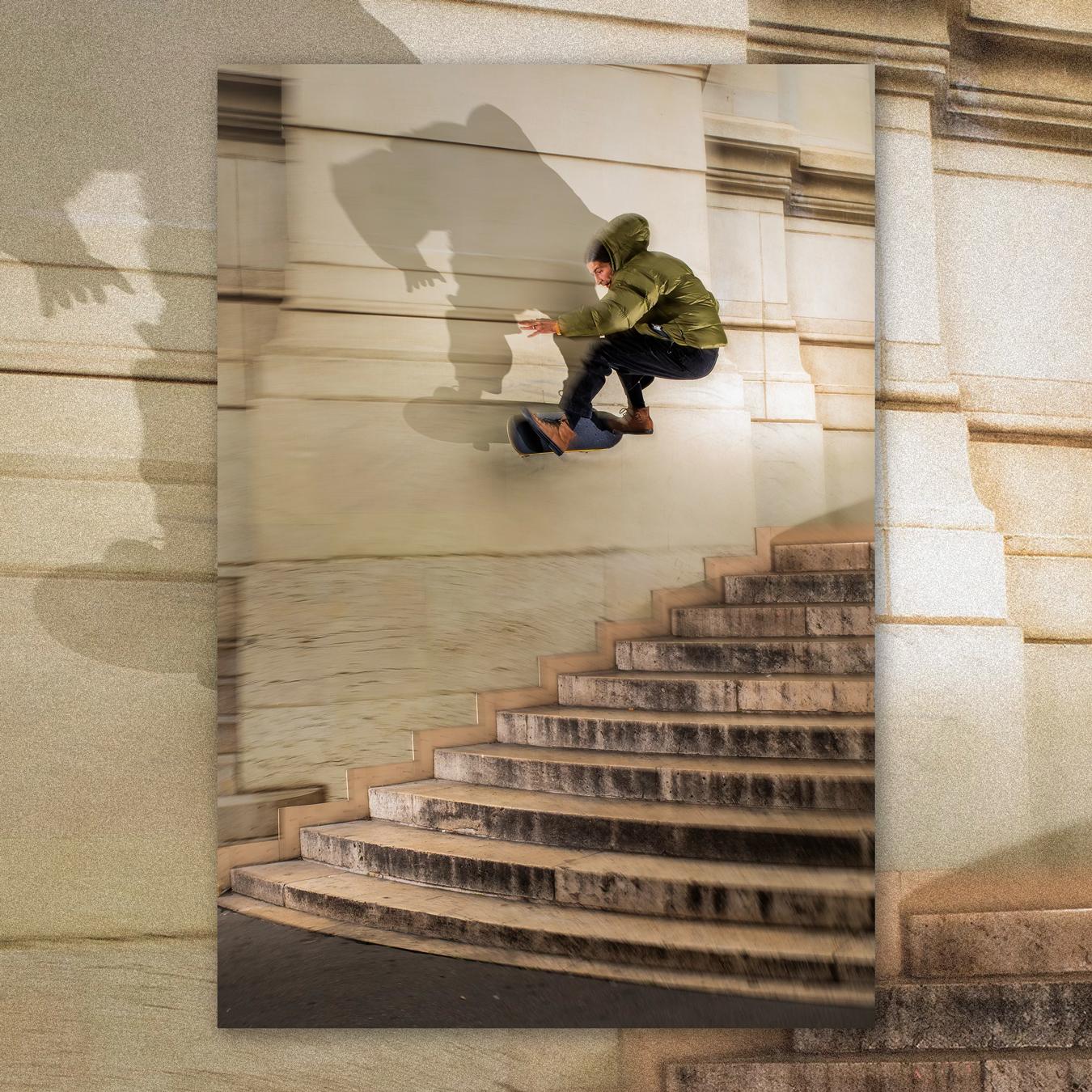
An alternate angle of González’s wallride, prior to him returning with Alex Pires for what became the cover of Free #58. Photo: Matt Price.
Price believes there’s a Venn diagram for skate magazine covers that has three circles — skater, trick, photo — and at least two need to overlap. “You need a sick skater and a sick photo, but maybe the trick isn’t so hot. Sometimes it’s a hot skater and a gnarly trick, but the photo can be totally ‘normal,’ an example of great skating from someone you love,” explains Price. As for Pires’ photo of González, “The Venn diagram circles are stacked in top of each other. That’s all three checked.”
The name of the restaurant that provided Pires’ vantage point, L’Entracte, is derived from the French expression “entr’acte,” which is an interlude performed between two acts of a play. Such a position feels reflective of the limbo state of skateboarding magazines in 2026. Depending on one’s media diet, print media has either dwindled or is flourishing. Thrasher may be the last bastion of the once numerous, monthly periodical. However, there are now many diverse titles publishing on a quarterly or an ad-hoc basis around the world (Vague, Pocket, Dolores, 2001, Bubble and Goblin to name a few of those not featured in this story; Thrasher editor-in-chief Michael Burnett did not follow up on interview requests for this story.)

Background Images: Felipe Bartolome, nosepick, Spain, Free Skate Mag #1 (2015). Photo: Sam Ashley • Una Farrar, Wallie, Canada, Mess Skate Mag #1 (2020). Photo: Norma Ibarra • Dylan Goldberger, nose yank, New York, Skate Jawn #1 (2010). Photo: Colin Sussingham • Portraits: Sam Ashley by Tom Quigley courtesy of Skate Nottingham, Jessie Van Roechoudt by David Serrano, Marcus Walrdon by Noah Halpern-McManus.
Regardless of whether today’s skateboard magazines are bought, picked up free at a shop or even read, their covers remain widely seen, celebrated and shared — albeit often digitally. The significance of getting a cover is perhaps the last spectacle that spans generations in skateboarding. To determine what a magazine cover “means,” and the editorial decisions behind how they are chosen, I spoke with Sam Ashley of Free Skate Mag (Europe), Jessie Van Roechoudt of Mess Skate Mag (USA & Canada), and Marcus Walrdon of Skate Jawn (USA), as well as Matt Price (USA) to explore the canvas for creativity that a cover can be.

Dylan Jaeb, switch kickflip, Southbank, London. Free Skate Mag #63 (2025). Photo: Rafal Wojnowski.
Is there a through-line to your covers, visually or tonally?
Sam Ashley, photo editor and co-founder, Free Skate Mag: We’re always striving for an amazing photo and an amazing trick. That’s the ideal. A great trick is going to get people excited, but a great photo is going to get people excited, too. I make it sound really simple, but we’ve had a lot of photos that almost ran as covers, which were great photos but the trick wasn’t that exciting or vice versa. It’s easy to put an insane trick on the cover, and we always want something more than that.

Dustin Henry, bump to frontside wallride. Mess Skate Mag #3 (2023). Photography by Mikaela Kautzy (pictured with Dustin, right), artwork by Max Wheeler.
Jessie Van Roechoudt, co-founder, co-creative director and co-editor, Mess Skate Mag: We try to get whoever has the main feature to have the cover, and ideally, a corresponding video part — but that’s hard to coordinate. We have a featured skater in each issue that has a skate interview and also a featured artist interview. We incorporate their artwork; it’s always evolving graphically. It’s a combination of who we’re representing, ensuring it’s diverse. Ideally it’s a creative trick that corresponds to the featured skater for the mag, and the artwork with that.
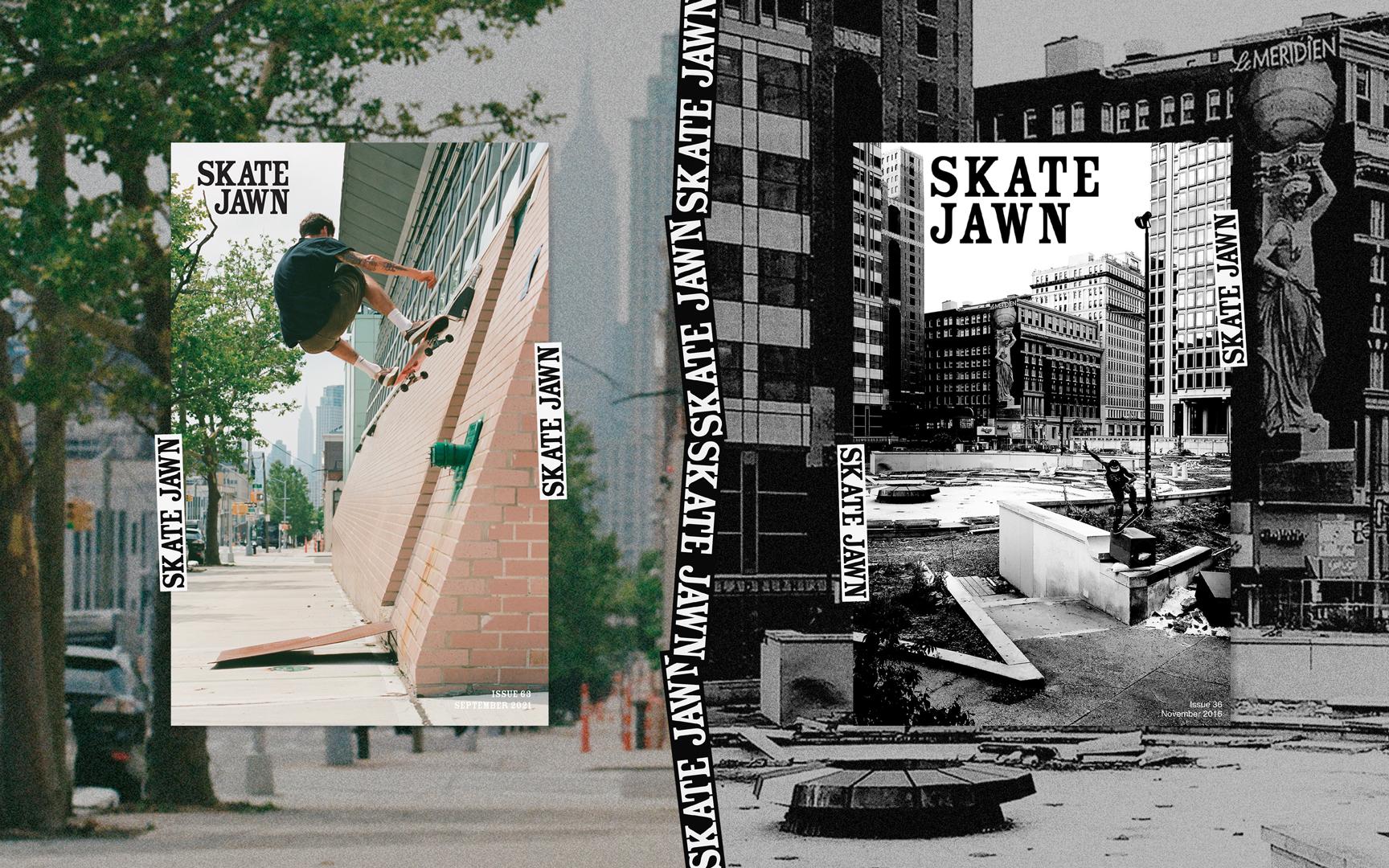
Andrew Wilson, frontside ollie, New York. Skate Jawn #63 (2021). Photo: Paul Coots •
Kevin Taylor, bluntslide, Love Park, Philadelphia. Skate Jawn #36 (2016). Photo: Sean Spellissy.
Marcus Waldron, founding editor-in-chief, Skate Jawn: The artistic value of the photograph is important. Even if it’s a gnarly trick, the cover needs to be beautiful. We have a place in our heart for D.I.Y., so that has its way of making it into the cover. Abandoned buildings, urban decay and things of that nature interest us. We like east coast vibes and textures. We’ve had some things come in that seemed not our “brand.” Too [perfect] looking. That’s not a deal-breaker, but an abandoned building fits a little better.
“You want covers to work on different levels where someone seeing it doesn’t have to know who it is for it to be exciting.” — Sam Ashley, Free Skate Mag
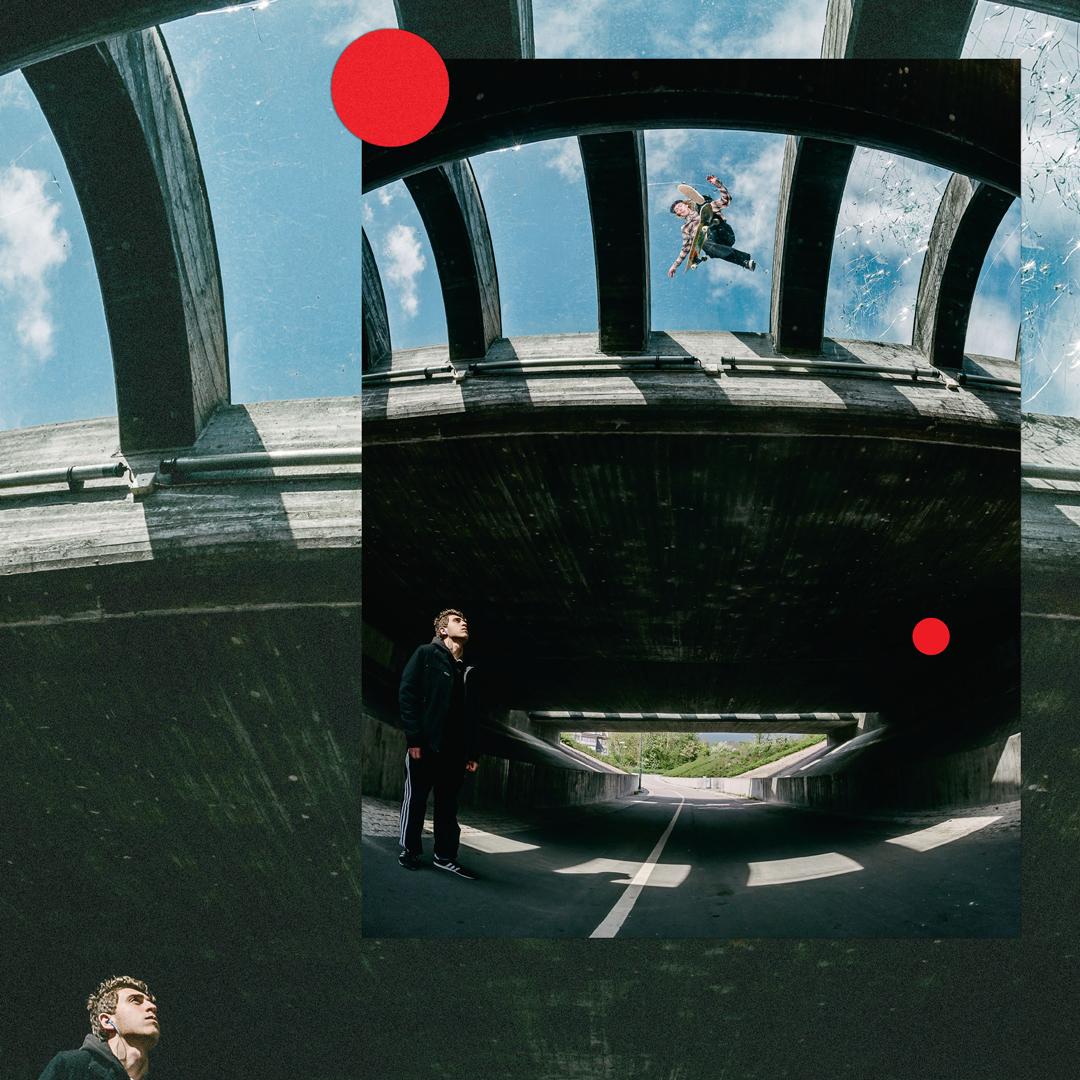
Amandus Mortensen, 360 flip, Malmö, Sweden. Free Skate Mag #3 (2015). Photo: Daniel Bernstål.
To what extent does the “star power” of a skateboarder or photographer factor into choosing a cover? Is a great photograph a great photograph regardless?
Sam: It’s not hugely important. The best skaters are always going to be in contention because they’re with the best photographers, but we’ve got no qualms about putting an unknown skater or a photo by an unknown photographer on the cover. You want covers to work on different levels where someone seeing it doesn’t have to know who the skater is for it to be exciting. For me, it’s a powerful cover when someone without much knowledge of skateboarding — a ten year-old kid who has been skating for a month — can pick up the magazine and be, like, “Wow, this is amazing!”
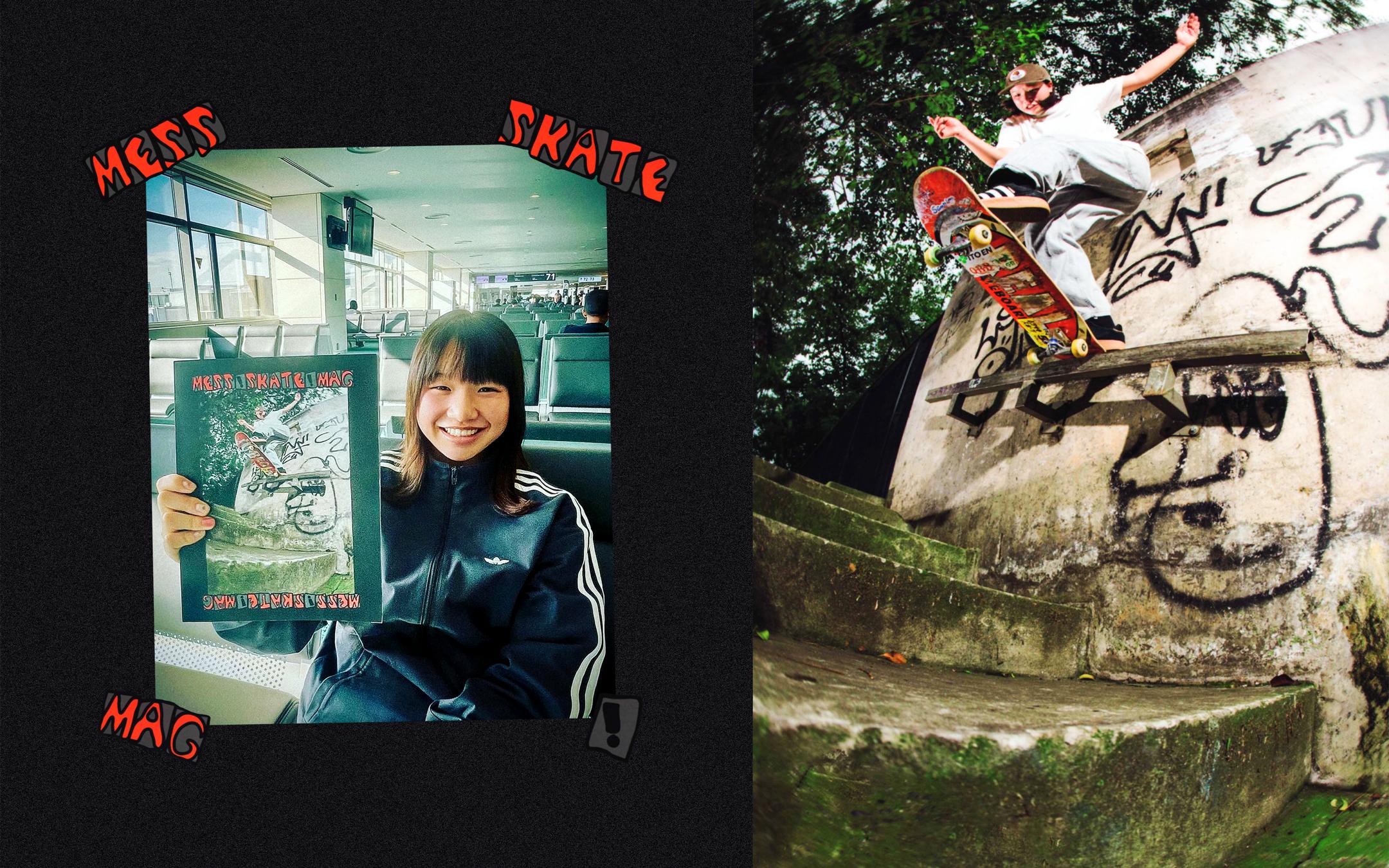
Momiji Nishiya, backside tailslide, São Paulo, Brazil. Mess Skate Mag #4 (2024). Cover Photo: Allan Carvalho. Photo of Momiji: Laurence Keefe. Artwork: Yom Tong.
Jessie: I don’t know if it’s about the audience’s attention. It’s more for us. The cover is the one thing we’re very specific about, but the rest of the magazine is pretty freeform. We’re trying to show a breadth of people. We’re all over the spectrum in terms of notoriety. I’m grateful we have established photographers in the magazine — it sets an example and helps with being taken seriously on the business end — but often, half the contributors haven’t had a photo published before, so I think we’re creating opportunity.
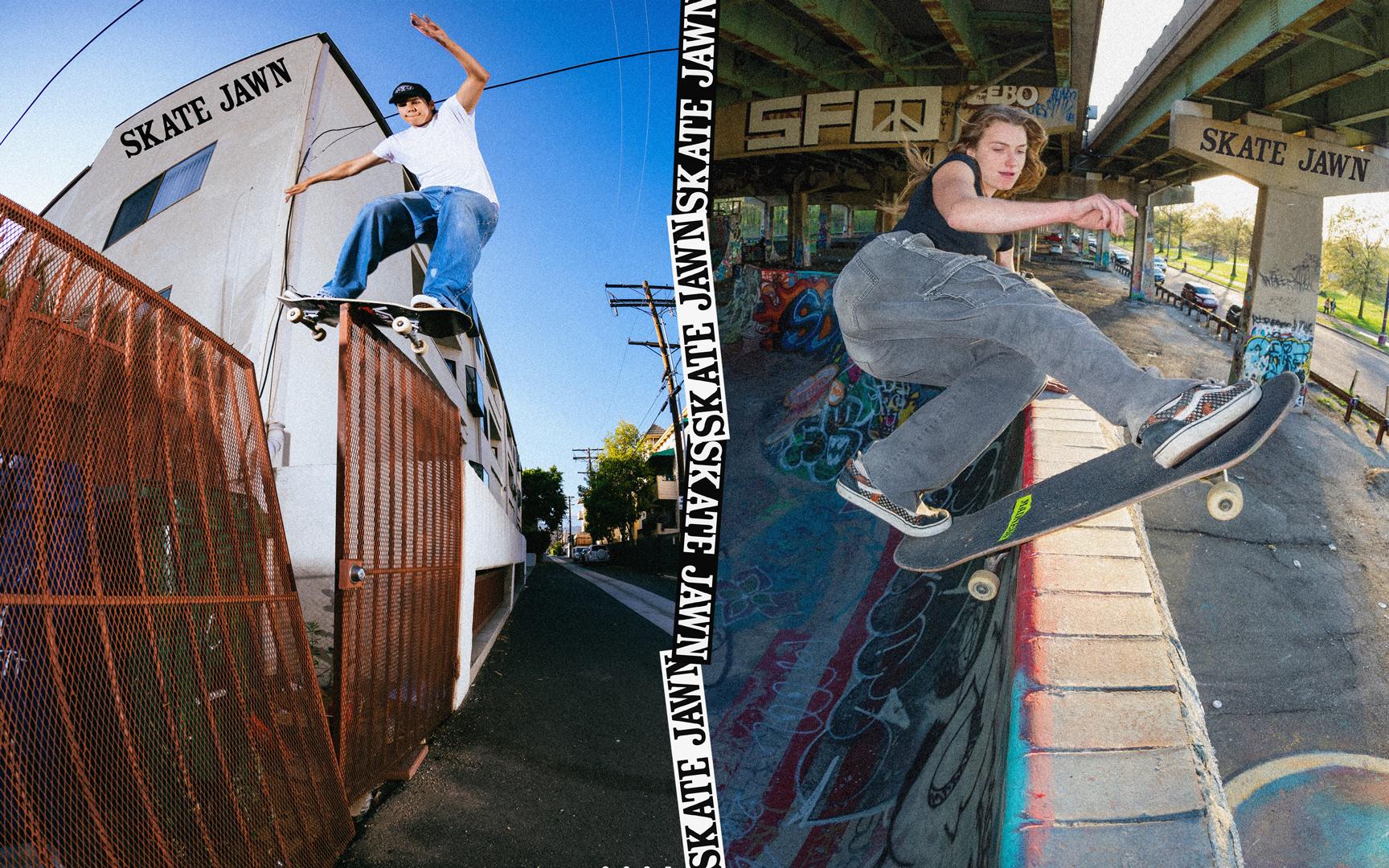
Nick Michel, boardslide into the banked fence, California. Skate Jawn 2025 Photo Annual (2026). Photo: Kris Burkhardt • Caroline Duerr, layback frontside rock-n-roll, FDR, Philadelphia. Skate Jawn #62 (2021). Photo: C.J. Harker.
Marcus: Sometimes, if we get a photo of a well-known person who checks our other boxes, it’s cool to have a name on the cover who would likely appear on any magazine. We follow the underground scene, and we like to give covers to people who haven’t had them before, or wouldn’t necessarily have them so soon. I love giving them to people we see coming up, and trying to give them cover before anybody else. We don’t chase notoriety, we try to show people who are coming next.
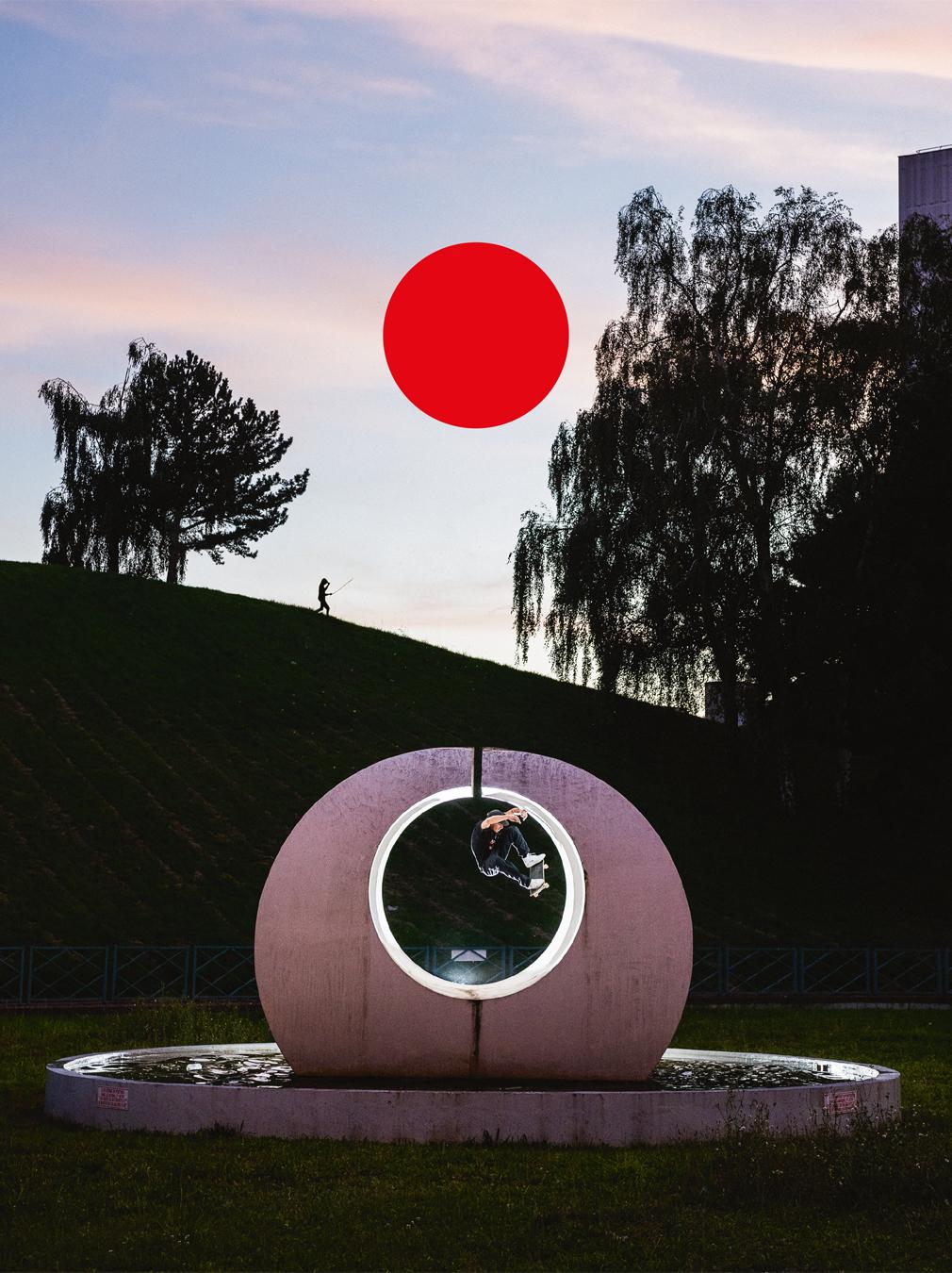
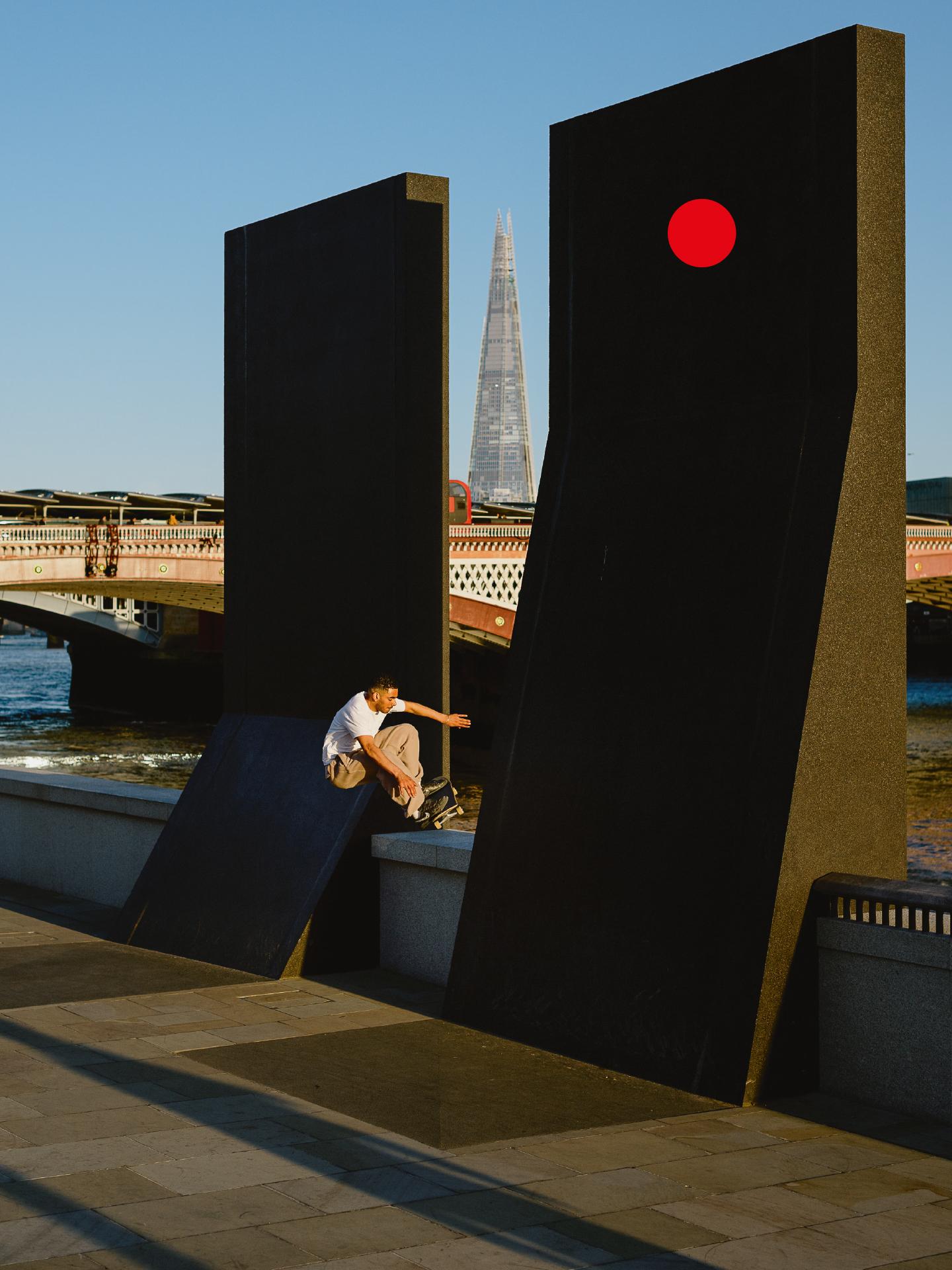
Phil Zwijsen, frontside ollie, Paris, France. Free Skate Mag #40 (2022). Photo: Alex Pires • Kyron Davis, frontside ollie, London, England. Free Skate Mag #66 (2026). Photo: Rafal Wojnowski.
Video is arguably now valued more than photography. How has that affected cover photos and magazine publishing in general when photographs of tricks being published have historically taken precedence over footage being seen?
Sam: A lot of the time, it’s just asking people to wait a little. Once it gets to the point of involving a photographer to shoot a trick, most people are willing to wait a few weeks to drop the footage. Skaters worry that someone else is going to do their trick on a spot, but for the most part, that mentality is impatience. If you wait, you’ll get a lot out of it, especially if you get a cover and an interview. At this point, the people we work with know the expectation. Most people who approach us are asking, “When can it run in the mag and when can we drop the footage?” It’s almost the day one question when a project begins. It sounds dry but it has to be that way. If you let it happen once, then everyone expects it to be the norm.
“The photo captures the pinnacle of the trick, the best slice of it …a distortion field of a moment in time.” — Jessie Van Roechoudt, Mess Skate Mag
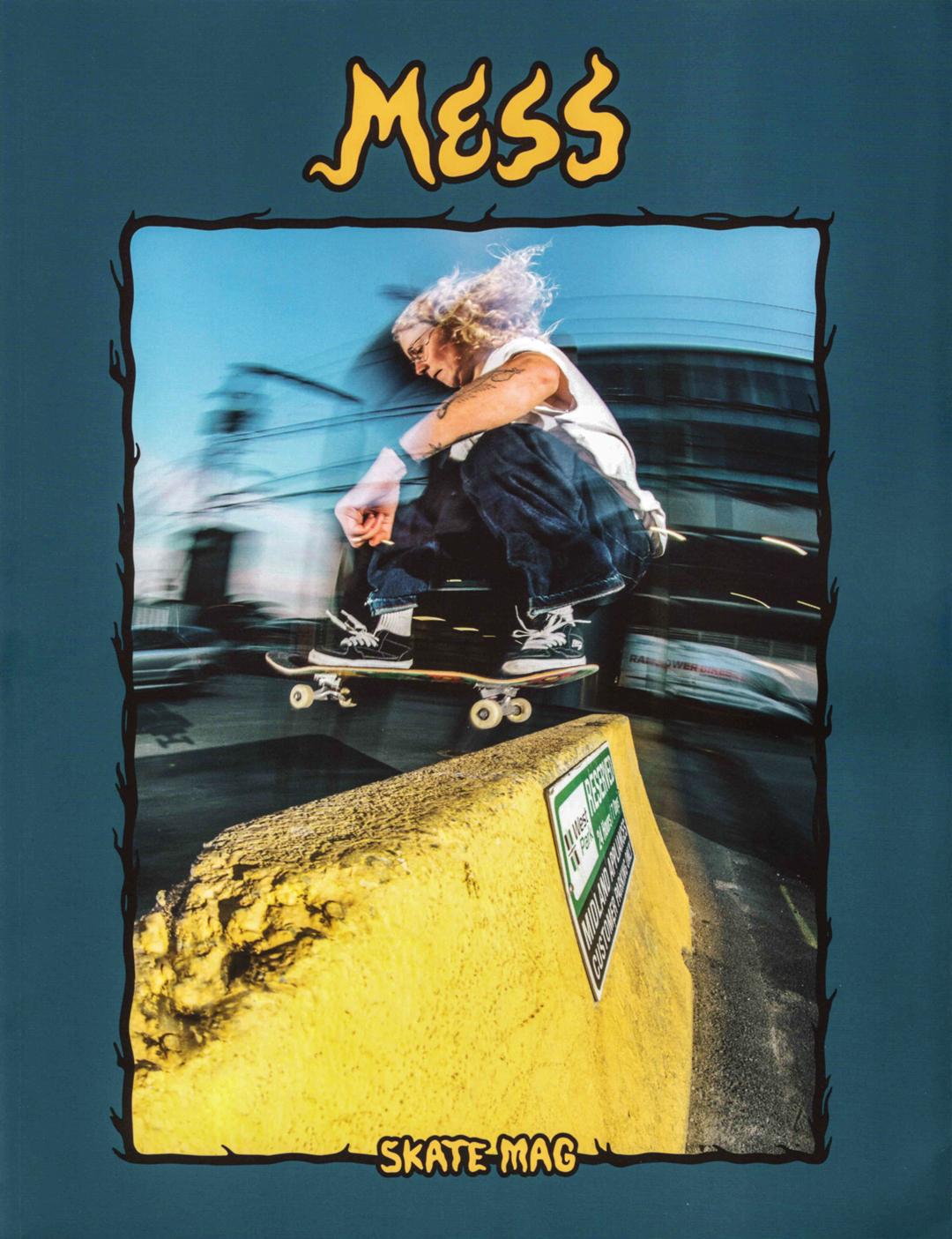

Una Farrar, wallie. Mess Skate Mag #1 (2020). Photo: Norma Ibarra. Diego Todd, backside 360. Mess Skate Mag #5 (2025). Photography by Anthony Acosta, artwork by Elise Hedge.
Jessie: The photo captures the pinnacle of the trick, the best slice of it. I disagree that the photo has to come out before the footage. In many cases, the photo looks so different. With video, there’s no mystery. Whereas the photo is artistry, a distortion field of a moment in time. You can perceive a trick in a way that you don’t when it’s passing in video. Matt Price’s fisheye photo is the Andrew Reynolds’ frontside flip of skate photography. Matt has also navigated that really well because he’s known for fisheye photos and still shoots other stuff. Before him, Mike O’Meally was the champion of fisheye. Or take French Fred [Mortagne], who has a perspective for a different kind of photo. Compared to footage, there’s more variety in photography.

Marie DeCourcy, 5050 gap out. Mess Skate Mag #2 (2022). Photo: Matt Price. Artwork: Shag.
*******
Matt Price on Artistry, Abstraction & Creativity in Magazine Covers
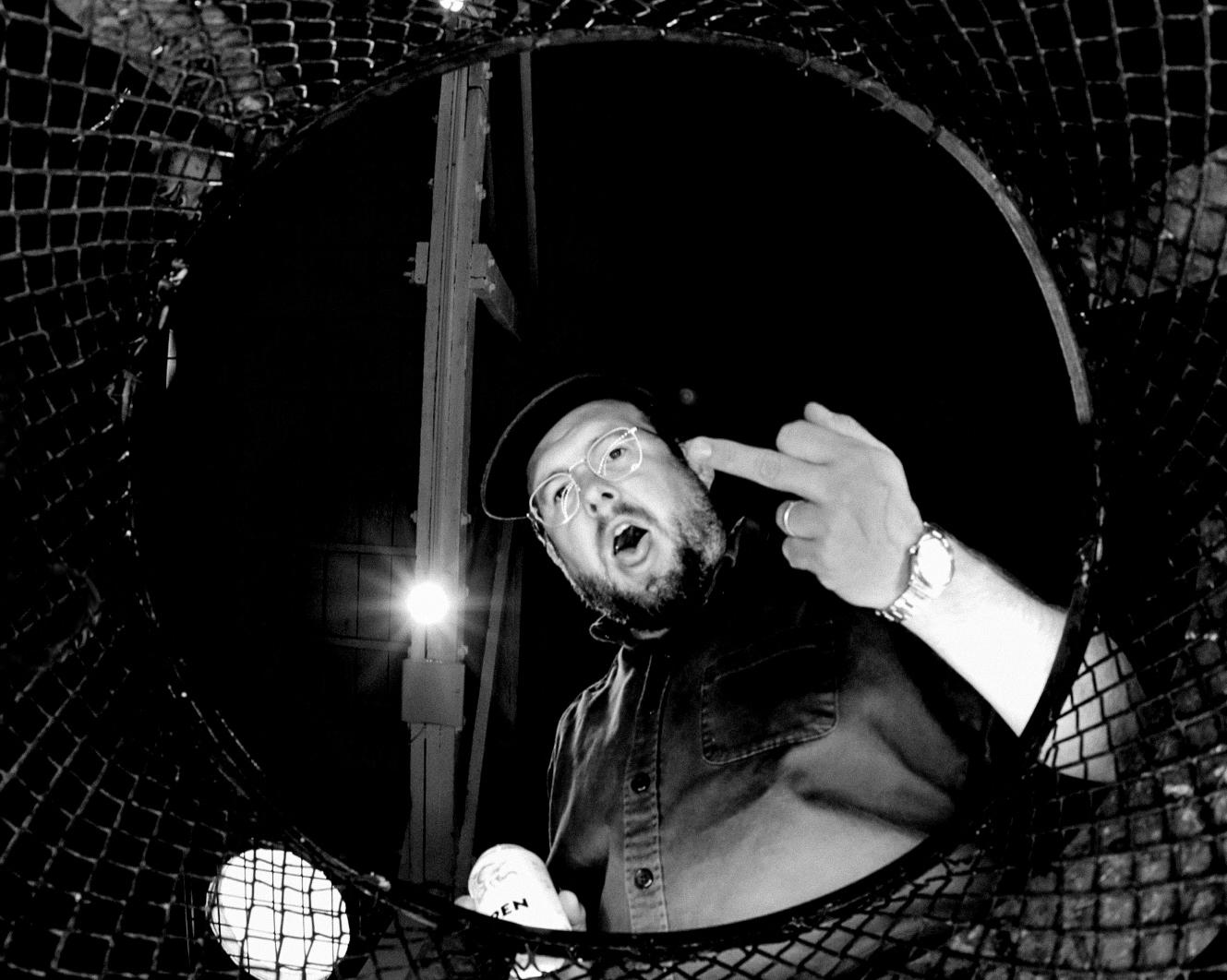
Matt Price, 2024, courtesy of Closer Skateboarding.
People get stuck in not seeing the best part of a photo or a trick because they’re following some rules. Someone will see the footage and get all of it there. The photo should be interesting no matter how you make it. — Matt Price
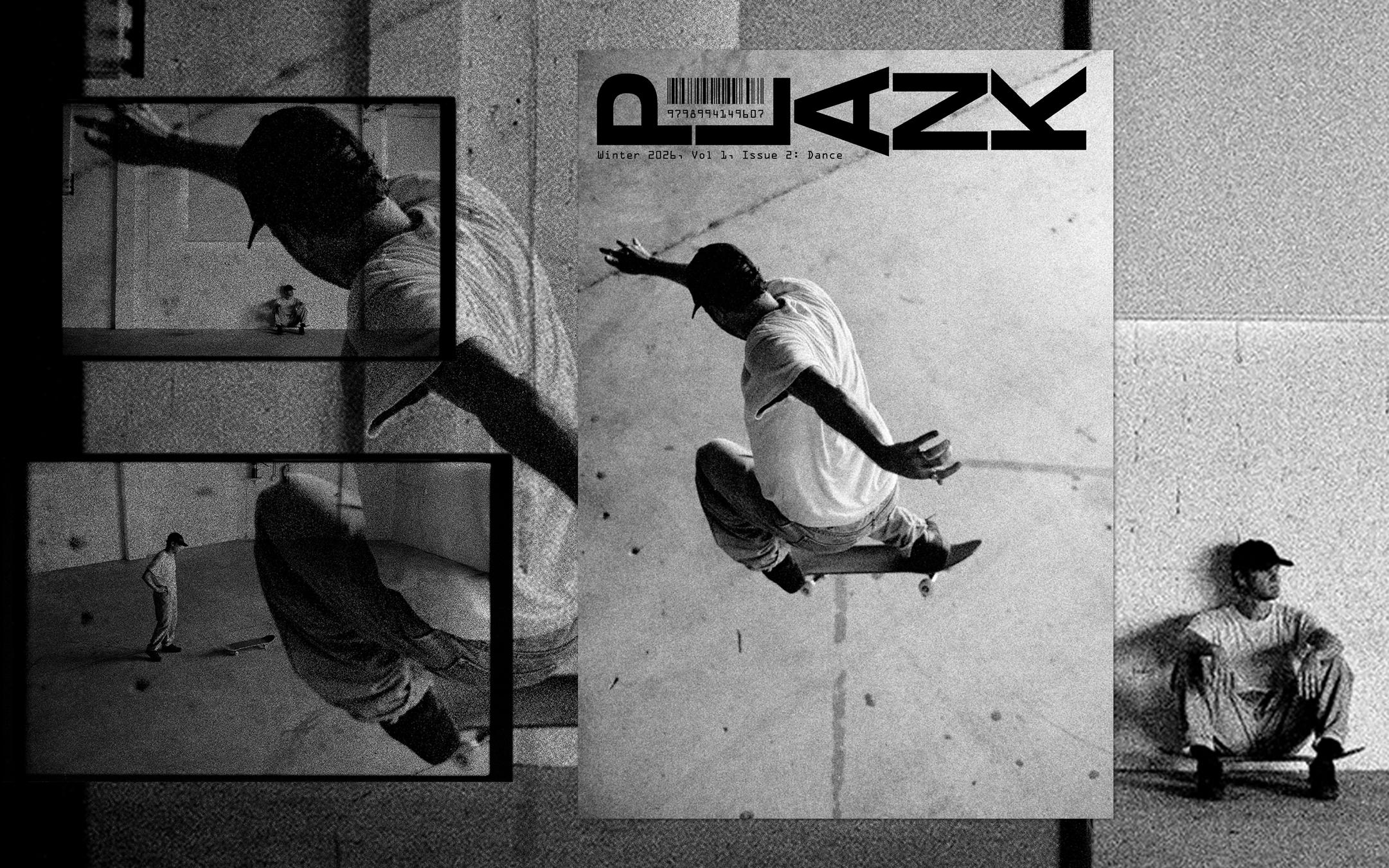
Brad Cromer, backside 360, Miami, Florida. PLANK #2 (2026).
Sam [Korman] reached out to me about PLANK’s second issue and told me the theme was dance. He threw out this idea of a beautiful flatground moment focusing on form — and the way the body moves — more than the trick. We thought of these old photos of [Mikhail] Baryshnikov dancing in old New York. It’s like they’re ballet studios, but you can tell they’re lofts on the Lower East Side or something. These rad black and white photos, doing leaps and using flash. We thought it would be cool to pick a skater who has great style to do something similar: put a skater in an empty room and see what they did, what their warm up routine was, where they ended up going, where they anchored themselves — that’s an interesting thing.
I thought Brad [Cromer] would be perfect. We rented a warehouse space and he was — not confused — but: “So, what are we doing?”
“You’re just going to skate flat and I’m going to take photos.”
I let Brad in there and said to skate around, warm up, do some kickflips, spin around. There are certain tricks of Brad’s that I love. He floats. It’s something about Brad that’s different to a lot of skaters.
I was also shooting moments where he would find a spot on the wall to wait between tricks. This desire to anchor came out where you find the little nook in the room, go out and do your little ballet, then come back and hang out there. There’s a pillar in the middle of the room and he’d avoid it to go in a circle; [it’s] this fun moment where he got as close as you can to go around this pillar without catching it, and he has to move his arm and face. You’re watching for that. It was really trying to find moments between the [act of] skating. The relationship to this empty space, but finding a way to make “spots” out of it.
In that photo, you barely see his board. The intention was to showcase the movement, the body, the bends, the arms, all that. When I saw it, I was like, “This is the shape. This is dance.”
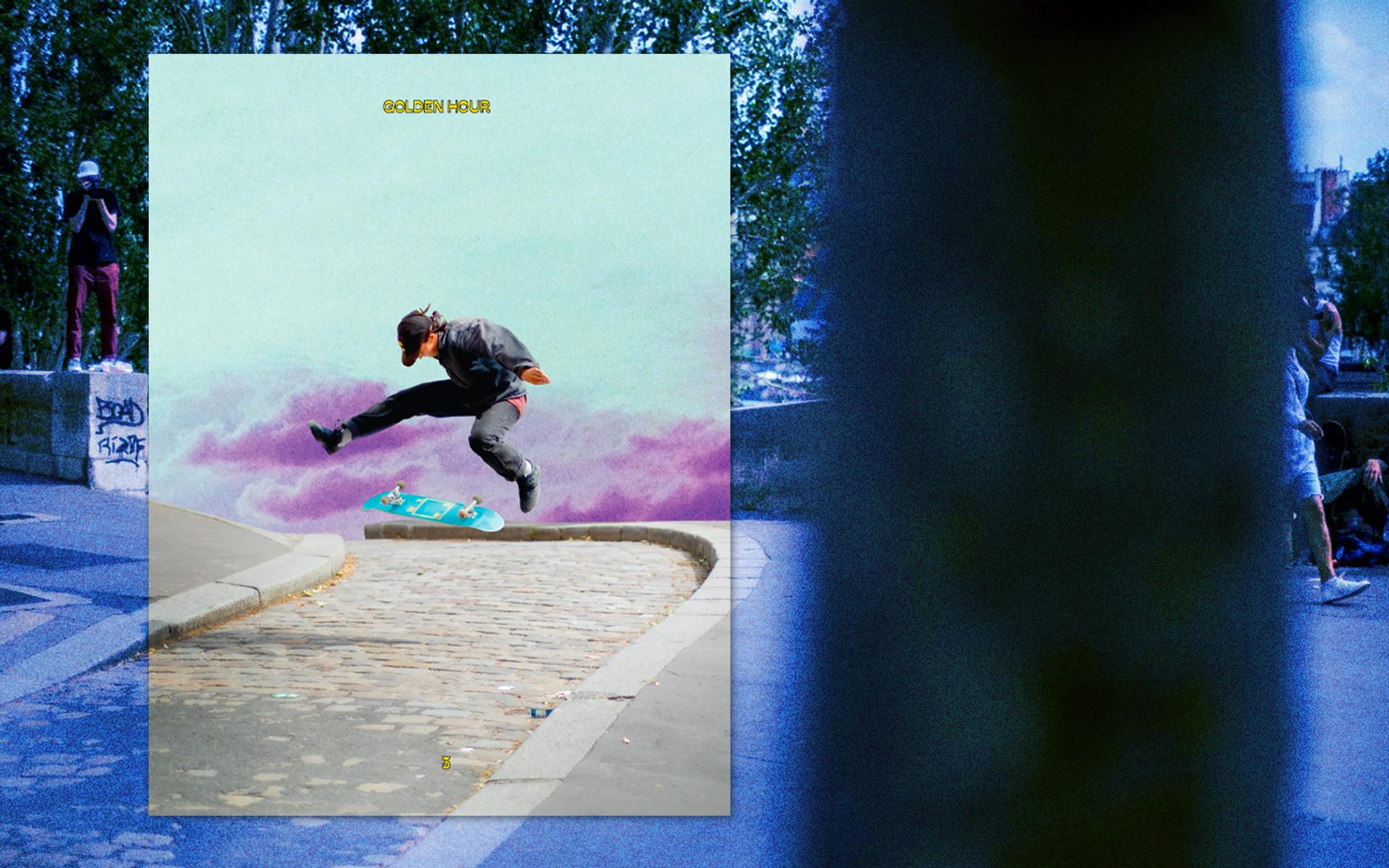
Alexis Sablone, heelflip, Paris. Golden Hour #3 (2020). Cover Design: Andrew McCarthy.
Alexis had a big Thrasher interview and I thought there were plenty of photos within it that should have been on the cover. There are lots of things that go into making a magazine; I’m not like, “They blew it!,” but it would have been a great opportunity to put someone iconic on there. Obviously, they made up for it later. But going into that trip to Paris — Golden Hour is a drop in the bucket by comparison — but I was like, “Alexis deserves to be on the cover of everything!” She’s so important.
Alexis has such a good heelflip flick. I was excited to shoot it early rather than the catch. The catch is the norm for flip tricks. People get stuck in not seeing the best part of a photo or a trick because they’re following some rules. Someone will see the footage and get all of it there. The photo should be interesting no matter how you make it.
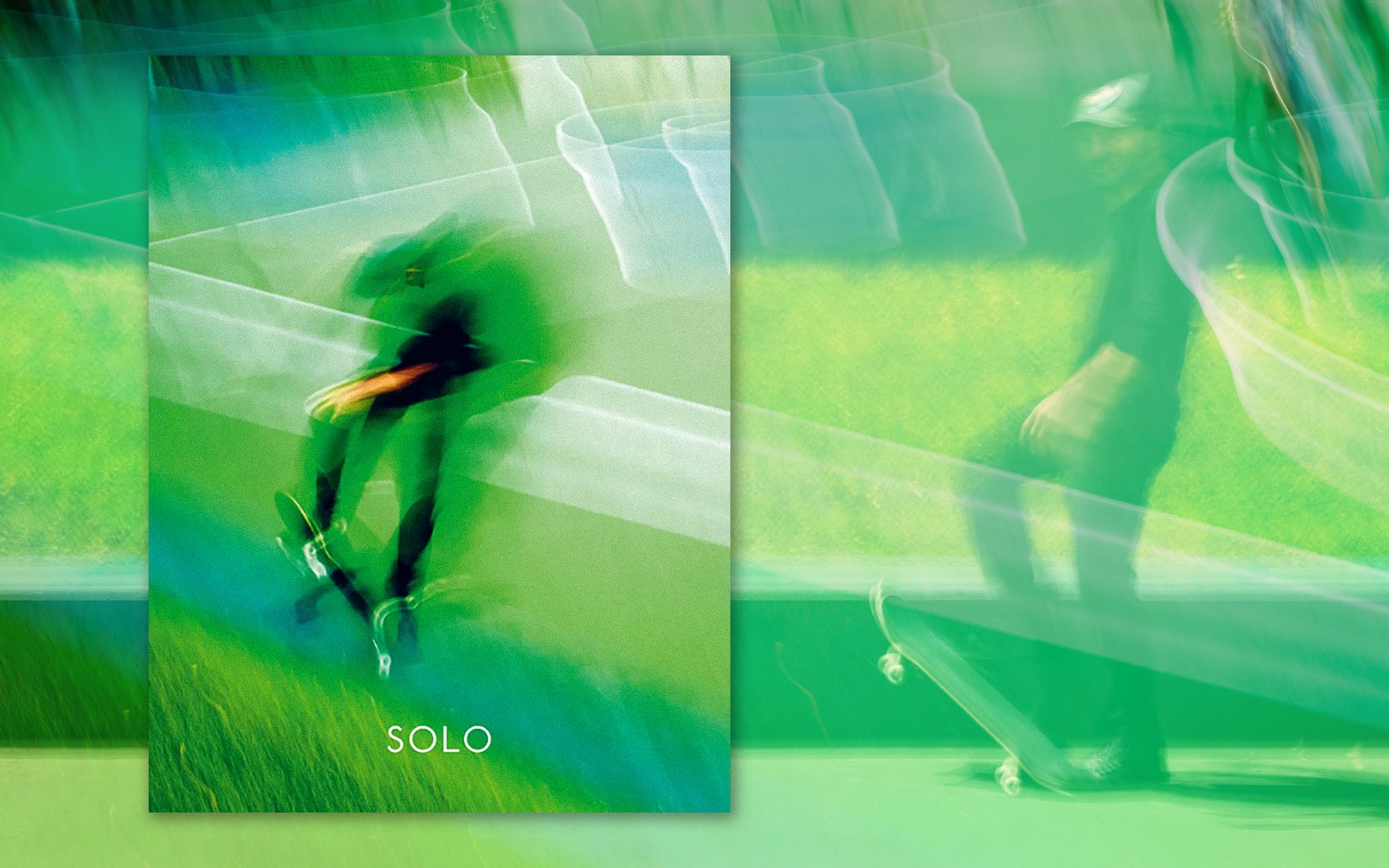
Heath Kirchart, frontside bluntslide, Los Angeles, California. Solo #50 (June 2023).
There’s a Thomas Campbell photo of surfers paddling out [from the book Seeing Fatima’s Eyes]. It’s a slow shutter and the sparkles on the ocean are blurred. It’s beautiful and I wanted to shoot a skate version of it. I wanted to find a blue basketball court and cover it in sequins so it would emulate the water sparkling and shoot at a one or two-second exposure so you can vaguely see what’s happening.
I was going to shoot it with Chris Millic and then I was at dinner with Heath, explaining what I was trying to do. I hadn’t heard back from Chris and Heath was like, “It’s a skate photo where its blurry and you wouldn’t see the face? I’d do that.” I’ve known Heath for 15 years and we’d never shot a skate photo before. We went to this green ledge in West Hollywood and I got up on a ladder. I didn’t have my sparkles and blue but it does the same thing and a front blunt is a good shape.
Solo reached out to photographers about a photo issue. They wanted us to push the envelope and send in a photo that we felt is the “future” of skate photography. I love this reduction thing where I remove as much information as I can. Thomas Campbell shoots surf photos where you break something down to its essence. Heath’s front blunt was a response to the digital age too. Everything is so sharp, has so much dynamic range, there’s so much information coming into our eyes all the time — so let’s take a little information out of the picture, give our eyes a break, and soften things up.
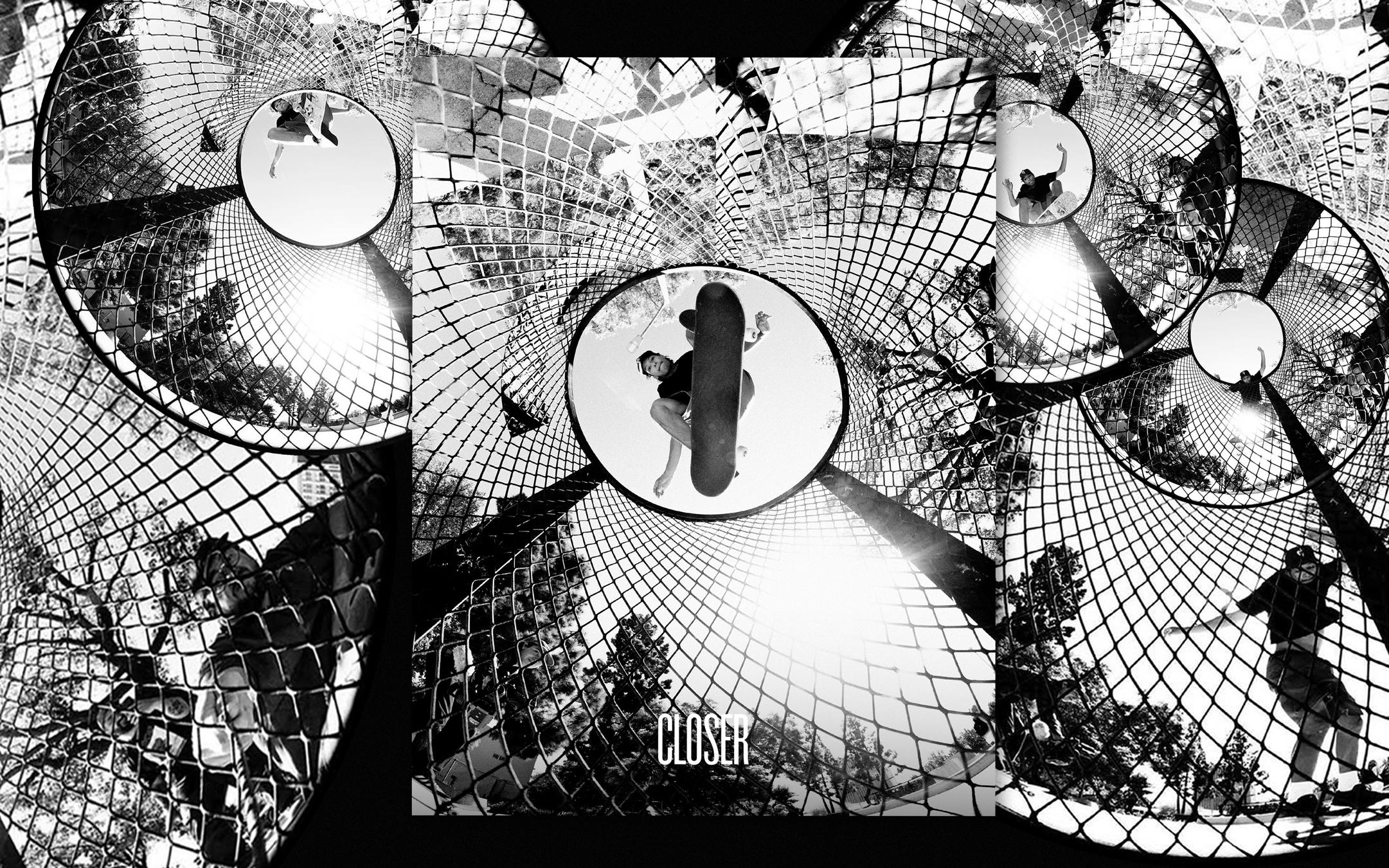
Louie Lopez, switch backside kickflip, U.C.L.A, Los Angeles. Closer #3 (2022).
You’ve gotta get a little bored sometimes. I was at the University of Southern California with amazing skaters doing every trick you could imagine over that can. It turned into “What can I do differently here?” I got so annoyed with my photos of that stupid spot that I put my camera under the trash can.
I shot it as a sequence so the timing of the photo is in no way due to me. At first, I didn’t even like that frame. I wanted the catch, but that frame was out past the rim of the trash can. I have this rule with bodies and tricks where you need asymmetry to make photos exciting because it’s not exciting when someone’s head is over the middle of their board. There’s nothing dangerous about that.
Louie’s photo was symmetrical and it annoyed me at first, but when I showed everyone on the session they were tripping. I was like, “Oh, I guess that’s the one. My call is wrong.” I knew it would be special based on the skaters we were with. Skaters aren’t losing their minds over skate photos anymore — especially looking in at a camera — but it was the likes of Louie, Ishod Wair and Alexis. It felt nice: “Maybe this is something people will care about?”
I reached out to [Closer founder and director] Jaime Owens, and I was like, “Cover?” That’s what’s nice about having a relationship with an editor. I’d never have the confidence to do that fifteen years ago.

Evan Wasser, drop-in, Isamu Naguchi’s “Red Cube,” New York City. Closer #10 (2025).
I was nervous that New Yorkers were going to be pissed about Zered Bassett already having “done this,” but I was also like, “Let’s see if this ruffles some feathers.”
We called Zered and got his blessing, so if Zered doesn’t care, then you shouldn’t care. I’d never seen [Red Cube] up close, and I immediately thought of Evan Wasser because he can take a splat. He met up with us and needed a rope because it’s too dusty to get up there. He rode his bike to an Ace Hardware four minutes before it closed, got a rope, he and Chase Walker tied it to the bottom and threw it through. He climbed up, tried, broke a board. Then tried it three or four times, getting as close to the top as he could without falling through because it’s a little peak up there.
The corner of the city wasn’t a happy accident. I immediately thought that if I shoot fisheye it’s going to look like he’s coming out of a portal from another dimension and splatting into New York. That was what I wanted, taking all reference away. You don’t need to see the whole cube. I just want him shooting out into New York City. The cool thing that was an accident — he’s sharp on that first frame and blurry on the second. If he’s “coming through a portal,” it looks like he’s about to atomize and maybe in the next frame he’d be back to being himself? I was on some sci-fi shit when I was editing that photo.

Founding editors: Sam Korman with PLANK #2: Dance (2026) and Jaime Owens with Closer #3 (2022) featuring Brad Cromer and Louie Lopez on the covers, respectively. Photo: Farran Golding.
*******
“Sometimes there are things happening that you can’t ignore in the world or around you. It makes your normal work feel ridiculous to be worried about. I think it’s natural for it to come through and when there’s no looking away.” — Marcus Waldron, Skate Jawn

Corey Bittle, alley-oop fakie 5-0, Richmond, Virginia. Skate Jawn #56: Photo Special (2020). Photo: Tyler Storm Brady.
Are there any considerations outside of skateboarding and aesthetics that influence cover decisions?
Marcus: I keep Skate Jawn focused on skating for the most part, but sometimes there are things happening that you can’t ignore in the world or around you. It makes your normal work feel ridiculous to be worried about. I think it’s natural for it to come through and when there’s no looking away. We don’t want to do the same thing over and over. We try to think of what we can do differently and what we haven’t done in a while.
Sam: No, but that goes back to wanting the cover to stand by itself. I always want it to be forward-facing. It’s important to write a new future. For the first issue [of Free, July/August 2015], Felipe Bartolome was, like, 16. To me, it was important to put someone new, fresh and exciting there and not lean on someone established. That’s too easy. We could’ve put some “legend of Europe” on the cover, but you’re trying to define what a magazine is about with your first issue.
Jessie: We don’t have many big advertisers, so we do want to have some value for them. I think if any skate mag doesn’t say that, they’re lying. Mostly, it’s about the featured skater and trying to create opportunity for a variety of photographers.

Sam Narvaez, noseslide, Portugal. Skate Jawn #74 (2023). Photo: Diego Sarmento. •
Rashad Murray, gap to backside tailslide, Washington D.C. Skate Jawn #72 (2023). Photo: Owen Basher.
Skateboarding has diversified greatly over the past decade. Are you conscious of representing that when it comes to selecting a cover image?
Marcus: There’s a lot of women out there, so they should be on covers. I’m Black, so we want to make sure we’re being diverse. There’s a lot of aspects to running a magazine and being representative is one of them. We have a wide network of photographers around the country and love showing off smaller scenes, lesser known skaters, spots that you haven’t seen or things that people aren’t tired of seeing.
Jessie: There’s a conscious effort, but we also don’t want to be pigeonholed as a “girl’s magazine,” and we have guys on the cover. The new generation is fully embracing [all aspects of] skateboarding being intertwined into one.
Sam: Yes, but it still would have to be the best photo for that issue. It just has to feel right.
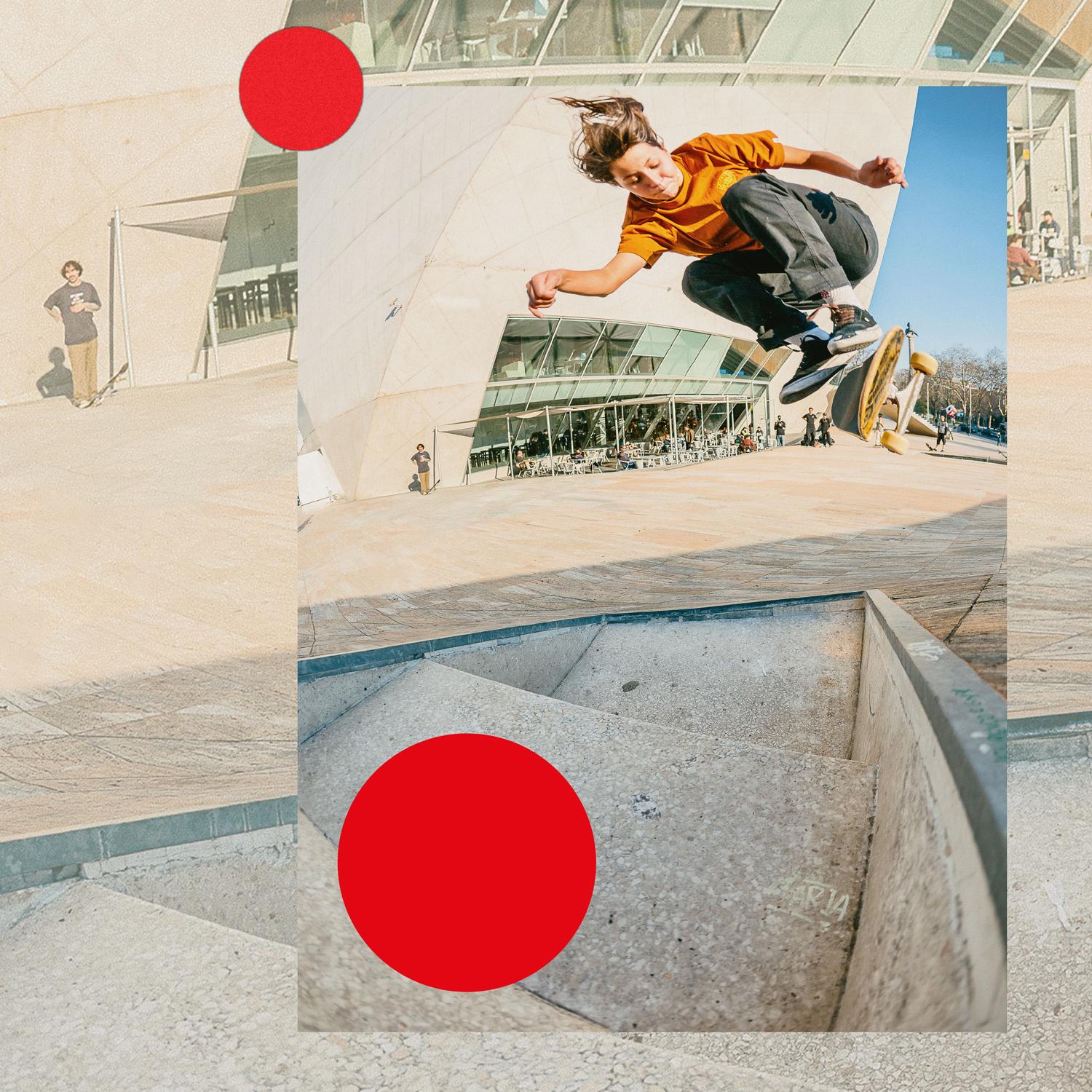
Rafaela Costa, backside kickflip, Porto, Portugal. Free Skate Mag #41 (2022). Photo: Ruben Morais Claudino.
Many people will see a magazine cover on social media before they see it in
tangible form. What does social media mean for the process of selecting a cover and gauging the response to it?
Sam: Absolutely nothing. We’ve had covers and while we’re laying it out I’m like, “This is not going to look good on Instagram,” but I don’t care because it’s going to look sick in print. Still, Instagram is where it gets announced on the day that shops start receiving the issue. If we don’t do that, then shops start posting about it and people start seeing it in other places, which then means people’s response to our post of the new cover is likely to be, “I’ve already seen that.” It’s still important to us that it gets likes because we know everyone looks at social media. That’s part of the process. But it doesn’t extend to the point where I would swap a cover for something I thought would do better on Instagram.

Jordan Trahan, frontside flip, Pittsburgh, PA. Skate Jawn #53 (2020). Photo: John Shanahan • Ty Beall, 5050, New York City, NY. Skate Jawn #68 (2023). Photo: Sean Bendon.
Marcus: You might look at the numbers on social media, but a photo translates differently in real life. Being a physical medium, if you’re going to spend the money to print it, you should prioritize the print looking good. I think the real-life print experience of the cover is the most important one.

Mess Skate Mag issues 1 to 4. Photo: Shari White.
Jessie: As someone who works in the skate industry for a company [adidas Skateboarding], I believe magazines provide a way for skaters to build their careers in a legitimate way. They’re out skating and posting clips on social media, but how does that stand out from everyone else? Being in a magazine is something to be proud of that people can share, that brands can share, and provide a way for skaters to share that isn’t, like, “bragging.” I’m not just saying this for Mess, I’m saying this for all magazines. What’s bad is that the industry hasn’t supported that as much as it could. I understand the industry is in a hard spot, so that’s not an accusatory position, but it needs to realize that magazines and publishing are the thing to invest in to allow the growth of the next generation.

Myquel Haddox, heelflip, Philadelphia, PA. Skate Jawn #88 (2025). Photo: Mike Bilyeu • Jake Johnson, backside tailslide, State College, PA. Skate Jawn #57 (2020). Photo: Mike Chinner.
What do you think a cover means to a skateboarder and photographer these days and what does a cover mean to skate culture?
Marcus: To have my friends get in or be on a magazine cover was the coolest thing growing up. People can promote themselves more with social media and are increasingly doing their own thing. But with all the saturation of images today — having the co-sign of a magazine, with money put into the printing and distribution, I hope that’s a validating thing that people are excited about.
Jessie: For a photographer it’s very significant, they often have it in mind. But I see younger generations of skateboarders who relate very much to video, because they’re used to consuming skateboarding in that form, and don’t understand what translates well to a still image. There was once a uniform acceptance of the way to show a trick, and now it’s changed because people aren’t seeing photographic media as frequently. I don’t think skaters expect covers as much, but once they get one, I hope it sparks them to shoot more photos.
“I used to have more covers before I was a photo editor… I’d rather give it to someone else, honestly.” — Sam Ashley, Free Skate Mag
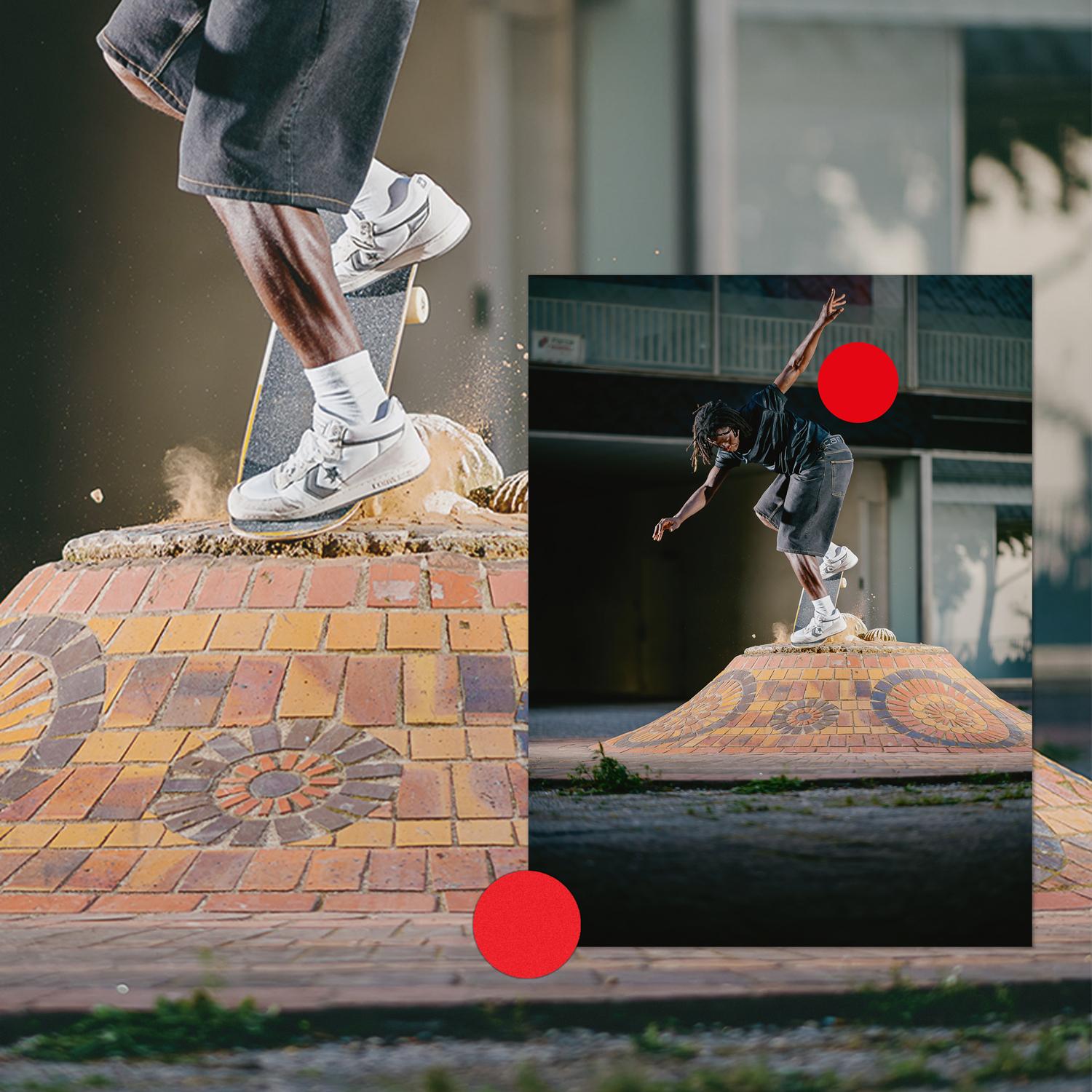
Ibu Sanyang, backside noseblunt, Lyon, France. Free Skate Mag #62 — the magazine’s tenth anniversary issue (September 2025). Photo: Sam Ashley.
Sam: If you asked all the skaters who have been on our covers, you’d get a lot of different answers, but it’s still one of the biggest accolades in skateboarding no matter the magazine. I guess photographers feel the same.
I used to have more covers before I was a photo editor. It’s mildly embarrassing to give yourself the cover, but sometimes it has to be like that. I’d rather give it to someone else, honestly. It’s hard when it’s your own photo. Not only in a way of feeling big-headed, but because you were there on the session, so you saw how difficult it was and how happy the skater was when they landed it. That completely ruins your objectivity. I think a lot of photographers struggle with this. You have to really strip it back and think: “If I wasn’t in this session, what would I think of this photo?”
Related: Skateboarding & The Silvester Screen — Five Videographers on Cinematic Influences in Skate Videos, ‘It Feels Like You’re Both Getting The Clip’ — A Reappraisal of Fisheye Cinematography
fantastic article! thanks for helping to deepen the culture’s understanding of itself
Great piece. Just one thing, are you sure the spot Felipe Bartolome skates isn’t Hoofddoep, Netherlands, rather than Spain? Pretty sure I’ve skated it