







📝 Intro + Interview by Adam Abada
📷 Photography by Jay Burles
He wouldn’t say this himself, in fact he went to pains not to – there were many a “maybe don’t air this” (a charming affect for a written interview) – for perfectly reasonable statements about his abilities, so I’ll say it about him: Will Marshall is really good at skating. And, as is often the case with such people, he prefers to let his skating do the talking. We thought it’d be good to try and get some of what makes him tick on the record, and the revelations from the mind of one of my favorites was worth the wait.
You were in Philadelphia, you were in New York. It is not like any of these places are in different time zones than Montreal. But still, you’re hard to pin down.
Before that, I was in Madrid. After, my homie from Australia was staying with me for fifteen days. I’ve been traveling for so long. It’s like second nature. I’m on call. Give me 24-hour notice and my flight confirmation number – I’m good. I’m almost more comfortable on the road than being at home.
Does that keep your skating flowing?
Definitely. I’m 32 now. I started skating when I was five years old. Being on the road is good because it’s the excitement of seeing new spots, seeing different people’s reactions. It’s not the day-to-day of what you’ve been doing for the past two decades.
“There’s no formula. If there was, I’d be taking advantage of it.”
Even so, you are putting out consistently high-level skating. How does that look from your side?
You could interview 500 skaters and I guarantee you 90% of them are gonna say “I’m my own harshest critic.” We keep a high standard for ourselves, especially in the generation that I grew up in. When the right person does something, it’s very impactful to me. The right person doing something at the right place – it means so much to me, so I try to emulate that feeling.
In my head, I’m capable of doing almost anything. It’s shower thoughts or what you think before you fall asleep. You’re not thinking about wind or your shitty griptape or that your shoes sucked that day. And it comes down to expectations versus reality. How do you apply your expectations to your reality?
So what’s the process for you to get a clip and make that happen?
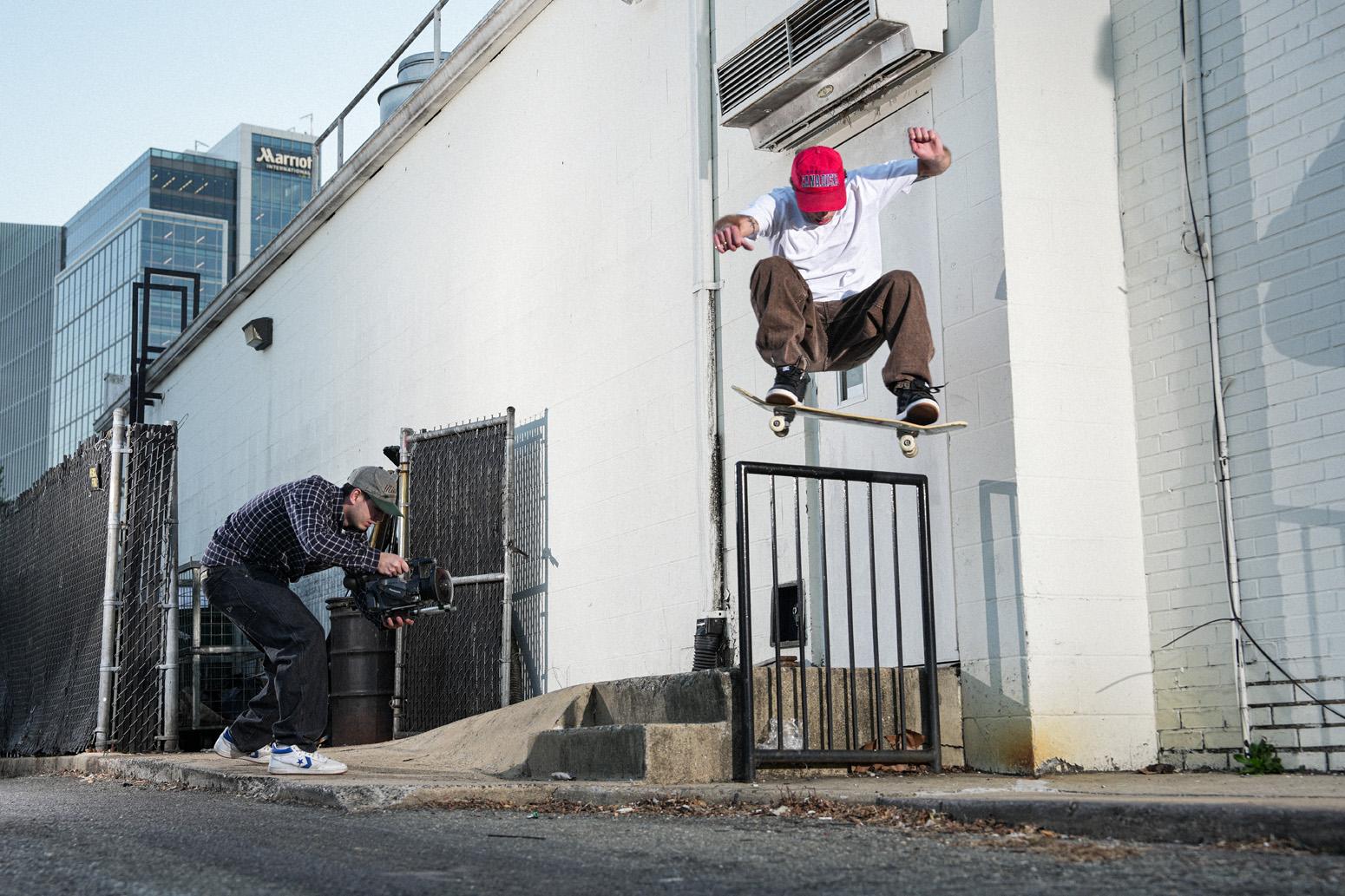
You’re not going to do anything if you don’t try to begin with. There have been times when I’ve tried tricks on multiple occasions, hours each day, and then one day, you do it in 15 tries when you didn’t feel like skating. There’s no formula. If there was, I’d be taking advantage of it. It’s tough to say, but just perseverance.
I feel like it’s similar with a lot of skaters, but for me, filming never stops — unless you get injured. I keep the rhythm going from one project to the next. Right now, for instance, I don’t know exactly what I’m working for next. That goes back to going on trips. You accumulate footage, see where you’re at, then a project comes and you see how you can fill in the blanks.
Can you tell me quickly a bit about growing up and what skating was like for you then?
I’m from Cornwall, between Ottawa and Montreal. It pretty much makes a triangle if you look at it on a map. I’m like an hour drive from Ottawa, an hour and twenty to Montreal, mostly because of traffic from the bigger city.
So you more or less stayed in the same region your whole life.
When people ask me where I’m from, I never say Ottawa or Montreal. Sometimes people will say the bigger place you’re near; I always say Cornwall. I was lucky to be right between Ottawa and Montreal. It’s a small town, but it made it easy for me to make connections in both of those cities rather than being just in Ottawa where it would be harder to go to Montreal. There were benefits in being from Cornwall. The population is 47,000. My parents realized that I gravitated towards skating at a young age and they knew how shitty my small town was, so they supported it. A lot of my best friends now, I’ve known for twenty years. Antoine [Asselin] from Dime, I’ve known for over 20 years. I’ve known Morgan Smith for 20 years. I’ve known Chuck [Charles Rivard] who rode for Alltimers for 20 years.
I won the lottery as a child with how supportive my parents were. They drove me to the indoor skate park in December when there was three feet of snow in Cornwall. I had my mom watching Flip Sorry fucking five times a week minimum. She was into it, too.
“Instead of getting frustrated that I’m missing tricks I should be making, I start trying tricks I don’t know. If I’m going to miss basic ass tricks, I may as well play around with my board and see what happens.
What’s your family’s history in Cornwall?
My parents are both pretty much born and raised within twenty minutes of Cornwall. At one point, there was a paper mill on the St. Lawrence River. It’s comparable to a small town in New Jersey. There’s a hospital. There’s a post office. There’s a couple high schools and not really anything specific. When I go back for Christmas, people ask me if I still skate, and I tell them I do. I ask them what they’re up to they’re like, “Well, I just got my forklift license.” I’m like: “Fuck yeah dog. That’s badass.” You gotta celebrate that forklift shit too, because I wasn’t expecting to make anything like a career in skating. I didn’t know what was gonna happen with my life – I hit the lottery – so you never know.
Lurker Lou has this theory that hockey players make good skaters, specifically good back tailsliders because of hockey stops and putting your body in that position. I know you played some hockey, do you think there’s anything to that?
I’ve played about three games of hockey in my life. Both my dad and his dad were professional hockey players. I don’t think there’s any ice in Brazil and Tiago can switch back tail for miles. But there’s probably some similarities. You have to be agile and aware. For instance, with hockey you need to keep your head up. You’re not going to handle the stick and look at the puck with your head down. If you’re about to pop onto a ledge, you don’t look at your feet necessarily right before you pop – you’re looking at where you’re going. If you don’t see your landing, you’re not gonna get there. You’re in the blind. You need to be aware of your surroundings.
I could see how those skills would translate.
If I ever have a child, I’m not gonna force anything onto them except for gymnastics and improv classes. If you’re a child and you do gymnastics, you get super agile. It’ll help you with any sport – hockey, basketball, skateboarding, whatever. And improv classes – if you get good at that as a child – you can finesse any job without even having to go to school. I think improv and gymnastics would be beneficial, not just for skateboarding, but for any realm. Improv is like the social skill and then gymnastics gets your body ready for whatever.
Did you take either?
No. Just skateboarding, which is both in a sense.
“I’ve learned a lot of tricks that way: just by having a bad session to begin with. You’ll surprise yourself from time to time.”
What thoughts go into how you pick which type of trick you want to film?
It’s skate brain shit. Skaters have different ways of putting together a project. Some people have trick lists. I remember having shit in my notes — not certain tricks at certain spots — but I remember that I wanted to have a trick in the rain. I did a trick on a sunny beautiful day, and then I realized that the ground was grippy enough there that it’d be a spot for a rain trick. Then we go and there’s just like a fucking river there. I thought it would be funny to do a trick in the sun, hop in the water, and then then next one is me doing a trick on it in the rain. I really had a lot of time to put that one together.
When you’re out at a spot, do you see what’s feeling good that day or what the spot calls for?
Your kickflip might be off that day, but your heel’s working. I got over the idea of chasing certain tricks at certain places. If I have something in mind, I’ll try it like ten times when I show up, but if it ain’t working, I know that maybe another day it’ll work quick. That’s worked in my favor a couple times where I get a trick I really liked that I wasn’t planning. It feels so good — you get high, kind of — because you didn’t lose sleep over it. Sometimes, it’s actually doper than what I had in mind.
In You Deserve It, what made you want to try back 180 nosegrind switch bigspin out on that diamond plated Philly step?
I remember I went to Miami four separate trips that winter. I was there for like five weeks. When we go on trips for Dime, you have to come correct for those iPhone clips. There’s a pretty high standard. I did a 180 back nosegrind like full circle, with the 180 out where it’s like doing a 360. The lock-in slipped out once and just zoomed me across the board and I almost did it by accident. I didn’t really have the idea. Sometimes shit just falls into your hands, in a sense. If I went there a week later, there’s a high possibility that it wouldn’t have worked at all.
Where do you work those tricks out? Are you just skating a lot?
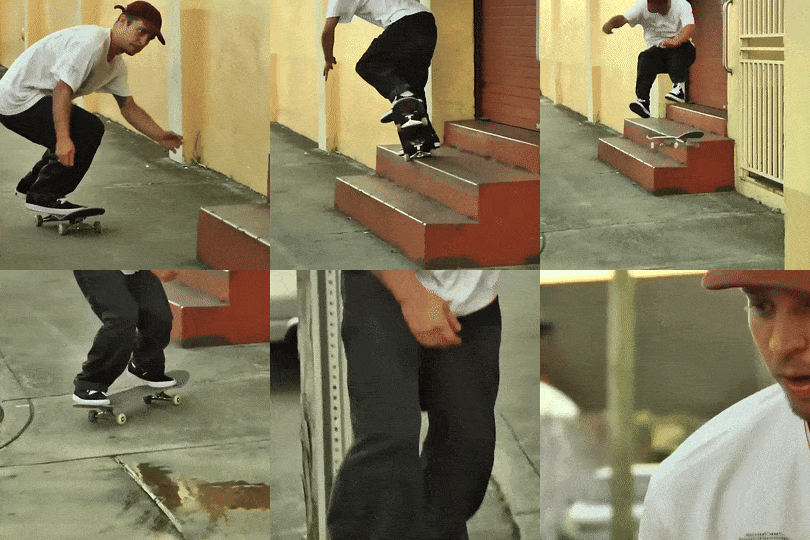
I was telling some kid at the skatepark the other day about this and it goes hand in hand with what you’re talking about. I’m warming up at the park: 50s, crooks, nollie crooks, tailslides, whatever. If that doesn’t work and I’m not having a solid day at the skatepark – I’m missing tricks that I think I shouldn’t be missing, like a tailslide on a ledge – instead of getting frustrated that I’m missing tricks I should be making, I start trying tricks I don’t know. If I’m going to miss basic ass tricks, I may as well play around with my board and see what happens. And then I won’t get upset about missing tricks. I started this within the past three or four years. You gain a little bit of intel on something new and go back with fresh legs. I’ve learned a lot of tricks that way: just by having a bad session to begin with. You’ll surprise yourself from time to time.
“Some people enjoy doing the dishes because it turns their brain off; I love being on the highway at night driving to a new city.”
Say it’s a Dime trip; there’s someone there filming for Dime. Is your footage from certain trips necessarily going exactly to that sponsor?
No. I feel like this isn’t the case for many “pro skateboarders.” I feel I’ve been hooked up in the sense of like: when I was working my “Welcome To DC” part, that was 80% from Alltimers trips. I’ve always skated for brands that are my friends who just want to see me shine. Alltimers are the ones that bought my meal that night or paid for the Airbnb, but they were – and I don’t want to put words in their mouth – down to do what was a good look for me with my footage. I put out a Dime solo part in 2021, and the majority of it was filmed by Matt Velez while he was making Bronze’s The Reuben. That Dime part could have been my Reuben part, in a sense.
What was it like on the inside as one of the older riders — even though I know you weren’t the first — when Alltimers called it?
I think Zach [Baker, former Alltimers team manager] called me second. And Sully [Salomon Cardenas] was in Montreal staying at my house because he was going to have a pro part. It was a Friday at like 3 P.M. I remember it vividly. I was unlocking bikes for us to go skate this spot for Sully to film a trick for his pro part.
I got a call from Zach and he said, “I’m gonna put you on speaker phone, I’m with Pryce and Rob [Alltimers’ owners].” I respond: “Wait, I’m in the streets skating right now, what’s good?” He’s like: “Timers is done.” I said I was with Sully right then, and asked if I should tell him and he said no, he would call him. Then I told him, “Don’t worry about the speaker phone. Let me digest this. We’ll talk later.”
I was in shock. I know that board brands have their target audiences and demographic. You go to L.A., you see everybody with Baker, Deathwish. You go to San Diego, you’re going to see Zero and SK8MAFIA. You go to S.F., you’re going to see Deluxe boards. At least in my demographic, people were supporting Timers hard. Boston. Montreal.
It seemed like a troll. They did the “Alltimers is going out of business” t-shirt and bankruptcy board, so I thought it was maybe a fib or marketing campaign. Those were literally the drop before. It didn’t settle in immediately. But it also didn’t take that much time for it to settle in. It’s a board company, and there’s however many other brands out there. They’re making martini t-shirts and shaped boards. I feel like that company started as an accident.
How did you get on?
Chuck, Ben [Blundell], and Dustin [Henry] were living together. E.T. [Etienne Gagne] was sleeping on the couch. Rob and Pryce saw something in those dudes. I was just there and that’s pretty much how I got on. I wasn’t one of the original dudes, but I was living with all them a bit. I was packing my bag about to go on a Dime trip to Copenhagen and Paris. I had spray-painted Element boards or whatever. Ben [Blundell] was like, “No dog, take my boards. I ain’t gonna skate.”
Ben’s the king of cool. He’s the freshest dude you know. Him giving me his boards — I’m like “Damn okay, the freshest dude is vouching for me.” It was truly an honor.
What’s it like being a non-board sponsored guy?
It’s cool in the sense of skating different shapes — shit that everyone who has ties to a board company would like to do. Regardless if I skate every day or not, I’m a nerd about it. It’s cool to try different things, but I want to be in a van. It’s not just about the boards. It’s about the team, the trips, different experiences and having another project to work towards.
It’s like meditation, in a sense. A flow where you’re peaceful. Some people enjoy doing the dishes because it turns their brain off; I love being on the highway at night driving to a new city. Something about being in the van. People will be like, “Dude, the flight’s so long!” I’m like, that’s the easiest part of our job. You sit your ass on the plane and arrive.
“The right person doing something at the right place – it means so much to me, so I try to emulate that feeling.”
Do you have any specific goals with sponsorship, now that you’ve already achieved the pro status.
I never thought about skating becoming a career of mine. Once the ball started rolling and I realized this is what I want to do, I realized that maybe I was built for it a bit. I’ve only set out two goals, really, that I never said out loud. Obviously, the number one goal was to have my name on a board. But my second goal, just like how I was bouncing between Toronto, Ottawa, and Montreal so much – I had all these places to crash at – I wanted to have that on the States side of the east coast. A huge goal of mine was to create friendships in Albany, Boston, New York, Jersey, Philly, D.C., Richmond, those places. I was able to accomplish that and that’s something I’m really proud of. That’s probably what’s still motivating me to skate. To be able to skate with the people that are making homie videos out all those places or are running the local scene and to have respect from them is a huge goal that I accomplished. That means so much to me.
You must have a few border stories.
Here’s one: one time I was taking the Greyhound to New York and was getting the classic questions: “Where are you going? How long are you staying? What do you do for a living?” I tell them I’m a professional skateboarder. They’re like: “Oh yeah? You’re a professional skateboarder? Taking the Greyhound? I guess you’re not in the X-Games.”
Just insulting me – like “some fucking pro.” But now I have a Visa!
Love when a skate interview is about skateboarding.
Canadian Legend
Albany loves Will
Real skater. insightful interview
Will is down to earth as fuck. I’m definitely taking the bad sesh-hack with me.